
How can the right expression make conversations about wellbeing clearer and more memorable? 20 Idioms for Health With Real Examples introduces useful phrases that describe physical condition, energy, recovery, and overall wellness. These expressions add figurative language and personality to everyday English while helping learners communicate naturally.
From casual conversations to formal writing, health-related idioms can make ideas easier to understand. This guide explains each expression through simple meanings, realistic examples, and practical usage notes. You will also see how English usage, grammar, and consistency can improve when idioms are used in the right context. The examples support clearer communication without forcing unnatural phrases into your writing.
Whether you discuss wellness during meetings, write health-related content, or communicate professionally, these expressions can strengthen your vocabulary. They can even complement business communication, scheduling, time management, online booking, broadcasting, calendar planning, and project management when health or wellbeing becomes part of the conversation.
What Is an Idiom?
An idiom is a fixed expression whose overall meaning cannot always be understood by taking every word literally.
For example, “spill the beans” does not mean physically dropping beans. It means to reveal a secret. Similarly, “break the ice” means to make people feel more comfortable in a social situation, not to crack a frozen surface.
Idioms differ from literal statements because they use figurative language. Their value comes from the mental picture or idea they create, which can make communication more colorful and memorable.
Why Use Idioms for Health?
Health is not only about physical condition. People also talk about energy, recovery, weakness, habits, emotional well-being, and vitality. Idioms give speakers and writers a compact way to express these ideas.
For example, saying someone is under the weather communicates that they are feeling unwell without sounding as clinical as saying they are sick. Saying someone is on the mend creates an image of gradual recovery.
Health-related idioms can help you:
- Express feelings of wellness or illness naturally.
- Describe recovery in a memorable way.
- Add warmth to personal conversations.
- Make stories and creative writing more vivid.
- Talk about healthy or unhealthy habits with personality.
- Communicate complex feelings through familiar imagery.
- Make everyday English sound more natural and expressive.
Quick List of 20 Idioms
- Fit as a fiddle
- Under the weather
- Back on your feet
- On the mend
- As right as rain
- In the pink
- Hale and hearty
- Fighting fit
- Run down
- Full of beans
- Breathe easy
- Kick the habit
- At death’s door
- Drop like flies
- A clean bill of health
- Take a turn for the worse
- Go from strength to strength
- Feel off-color
- In good shape
- Keep body and soul together
Fit as a fiddle
Read more:20 Idioms for Lost With Real Examples
Meaning
Fit as a fiddle means being very healthy, strong, and physically fit. The phrase creates a playful image of something working perfectly.
In a Sentence
After months of regular exercise, Grandpa is still fit as a fiddle and enjoys walking every morning.
Other Ways to Say It
- In excellent health
- Very fit and healthy
- Full of vitality
- In great physical condition
Explanation
The expression compares a person’s condition to a well-maintained fiddle that works properly. It is usually positive and cheerful, making it useful when someone wants to emphasize strong physical health.
Best Use
It works especially well in everyday conversations, storytelling, personal messages, and informal writing. It can sound playful rather than medical or professional.
Under the weather
Meaning
Under the weather means feeling slightly ill, tired, or generally unwell.
In a Sentence
I’m feeling a little under the weather today, so I’ll probably stay home and rest.
Other Ways to Say It
- Feeling unwell
- Not feeling myself
- Feeling poorly
- A little sick
Explanation
The expression creates an image of someone being affected by unpleasant weather. It usually suggests a mild or temporary illness, rather than a serious medical condition.
Best Use
This is especially natural in casual conversations, emails, messages, and everyday storytelling. It is less suitable for formal medical communication.
Back on your feet
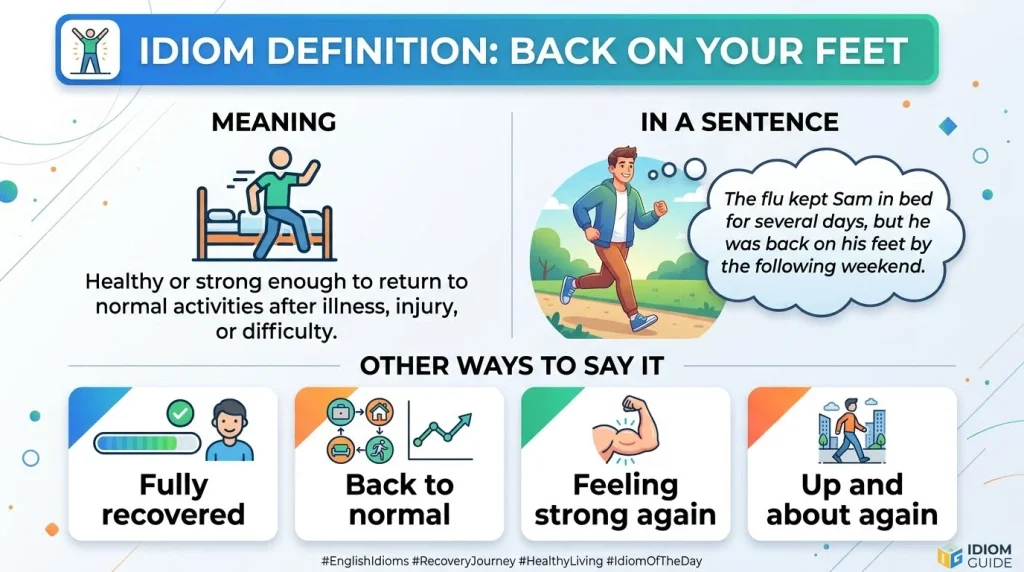
Meaning
Back on your feet means healthy or strong enough to return to normal activities after illness, injury, or difficulty.
In a Sentence
The flu kept Sam in bed for several days, but he was back on his feet by the following weekend.
Other Ways to Say It
- Fully recovered
- Back to normal
- Feeling strong again
- Up and about again
Explanation
The phrase creates a clear physical image: someone who was unable to stand or function normally is now upright and moving again. It often carries a feeling of recovery and renewed independence.
Best Use
Use it in conversations, personal stories, encouraging messages, and informal writing when discussing recovery.
On the mend
Meaning
On the mend means gradually recovering from an illness or injury.
In a Sentence
The doctor says Dad is on the mend, although he still needs plenty of rest.
Other Ways to Say It
- Recovering well
- Getting better
- Improving steadily
- Healing
Explanation
“Mend” is associated with repairing something that has been damaged. Applied to health, it suggests that the body is slowly returning to a healthier condition.
Best Use
This expression fits naturally in personal conversations, supportive messages, stories, and informal updates about recovery.
As right as rain
Meaning
As right as rain means feeling completely well or back to normal after feeling unwell.
In a Sentence
I thought the long journey would leave him exhausted, but after a good night’s sleep, he was as right as rain.
Other Ways to Say It
- Feeling perfectly well
- Back to normal
- In fine condition
- Feeling great again
Explanation
The expression uses the idea of rain being a normal part of nature to suggest that everything is exactly as it should be. When applied to health, it gives recovery a reassuring and upbeat tone.
Best Use
It is most natural in informal speech, friendly messages, and light storytelling. It can sound distinctly conversational.
In the pink
Meaning
In the pink means being in very good health or excellent physical condition.
In a Sentence
After changing his routine and getting more sleep, he says he feels in the pink again.
Other Ways to Say It
- In excellent health
- Feeling great
- In top condition
- Bursting with vitality
Explanation
The expression is associated with a healthy, fresh appearance. It presents wellness as something visible and energetic, rather than merely the absence of illness.
Best Use
Use it in informal conversations, descriptive writing, and humorous or slightly old-fashioned storytelling. It may sound less common in very formal modern English.
Hale and hearty
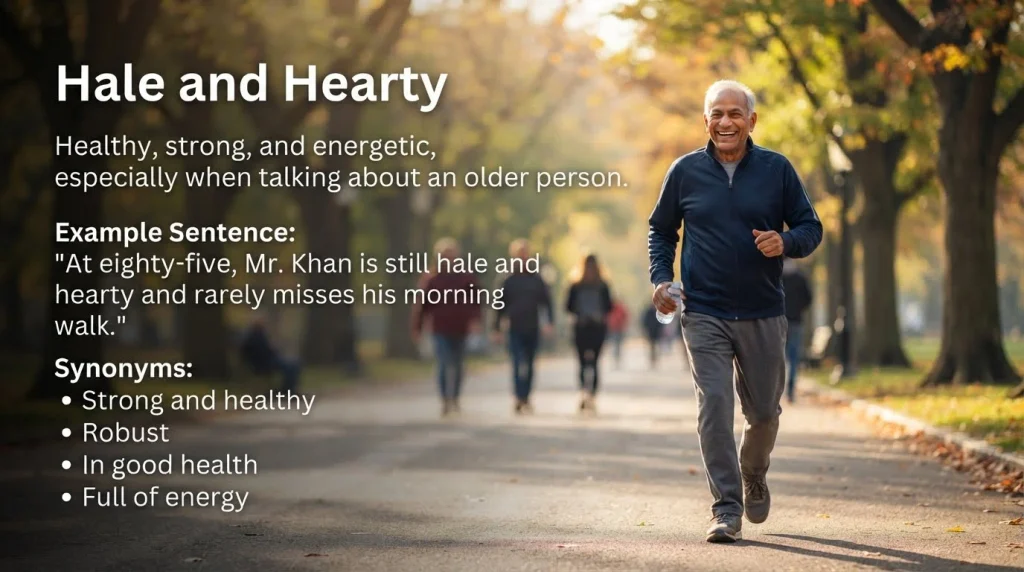
Meaning
Hale and hearty describes someone who is healthy, strong, and energetic, especially when talking about an older person.
In a Sentence
At eighty-five, Mr. Khan is still hale and hearty and rarely misses his morning walk.
Other Ways to Say It
- Strong and healthy
- Robust
- In good health
- Full of energy
Explanation
The two words reinforce one another: “hale” suggests good health, while “hearty” suggests strength and vitality. Together, they create a warm picture of robust well-being.
Best Use
This idiom is especially effective in storytelling, family conversations, biographies, and descriptive writing. It has a somewhat traditional feel.
Fighting fit
Meaning
Fighting fit means being extremely healthy, energetic, and physically ready for demanding activity.
In a Sentence
After months of training, the athletes arrived at the competition fighting fit.
Other Ways to Say It
- In peak condition
- Extremely fit
- Ready for action
- In top physical shape
Explanation
The expression comes from the idea of being physically prepared for a fight. It emphasizes strength, stamina, and readiness, rather than simply saying someone is healthy.
Best Use
It works well in sports writing, action-oriented storytelling, informal conversation, and motivational contexts. It can sound too dramatic for a routine medical discussion.
Run down
Meaning
Run down means feeling tired, weak, or lacking energy, often because of stress, illness, overwork, or lack of rest.
In a Sentence
I’ve been working late for weeks, and now I’m feeling completely run down.
Other Ways to Say It
- Exhausted
- Worn out
- Drained
- Low on energy
Explanation
The phrase suggests that a person’s physical or emotional energy has been gradually used up. It is useful because it can describe general weakness without identifying a specific illness.
Best Use
Use it in everyday conversation, workplace discussions, personal writing, and informal health-related descriptions.
Full of beans
Meaning
Full of beans means being very energetic, lively, and enthusiastic.
In a Sentence
The children were full of beans after spending the afternoon playing outside.
Other Ways to Say It
- Full of energy
- Lively
- Energetic
- Bursting with enthusiasm
Explanation
This playful expression suggests that someone is packed with energy and ready to move. It is more about vitality and liveliness than medical health.
Best Use
It is particularly suitable for casual conversation, children’s stories, family writing, and playful descriptions.
Breathe easy
Meaning
Breathe easy means to relax because a worry, danger, or difficult situation has passed.
In a Sentence
Once the doctor confirmed that the results were normal, the family could finally breathe easy.
Other Ways to Say It
- Relax
- Feel relieved
- Stop worrying
- Put your mind at ease
Explanation
Breathing naturally becomes easier when tension disappears. The expression therefore connects physical breathing with emotional relief and reassurance.
Best Use
It works especially well in personal stories, conversations, news-style writing, and supportive messages where health-related uncertainty has been resolved.
Kick the habit
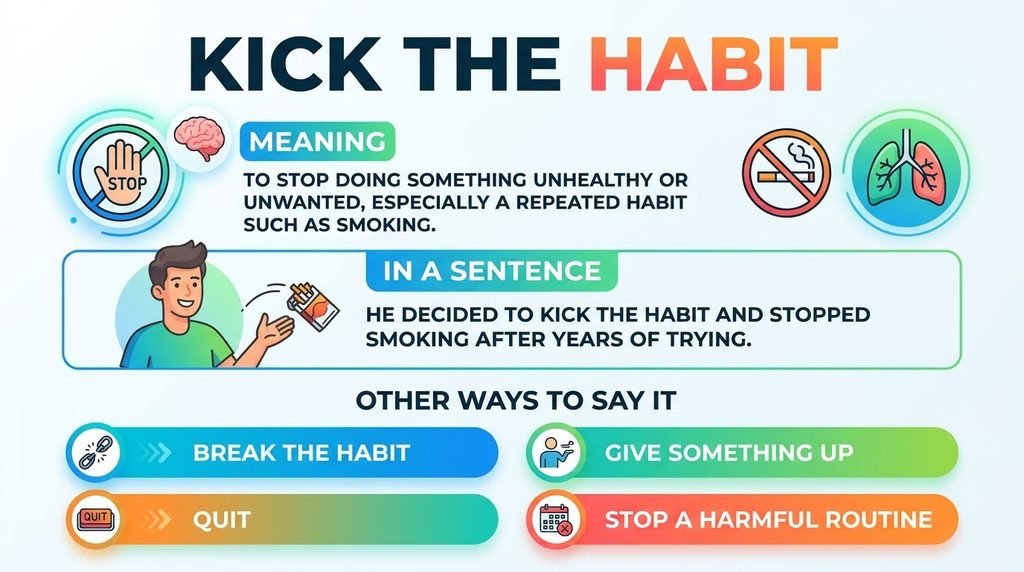
Meaning
Kick the habit means to stop doing something unhealthy or unwanted, especially a repeated habit such as smoking.
In a Sentence
He decided to kick the habit and stopped smoking after years of trying.
Other Ways to Say It
- Break the habit
- Give something up
- Quit
- Stop a harmful routine
Explanation
“Kick” gives the expression a sense of force and determination. It suggests actively pushing an unwanted behavior out of your life rather than simply reducing it.
Best Use
This idiom is useful in health discussions, motivational writing, conversations, and personal goal-setting. It is especially effective when discussing difficult habits.
At death’s door
Meaning
At death’s door is a dramatic idiom meaning someone is extremely ill or close to death.
In a Sentence
The old sailor looked at death’s door after being stranded without food or water for days.
Other Ways to Say It
- Critically ill
- Extremely sick
- In very serious condition
- Near death
Explanation
The image is deliberately dramatic: a person is imagined as standing close to the boundary between life and death. Because of its intensity, it should not be used casually about ordinary illness.
Best Use
It is best suited to fiction, dramatic storytelling, literature, and highly emotional descriptions. It may sound insensitive in serious real-life situations.
Drop like flies
Meaning
Drop like flies means that people or things are falling, becoming sick, failing, or disappearing rapidly in large numbers.
In a Sentence
During the exhausting hike, the participants started dropping like flies from fatigue.
Other Ways to Say It
- Fall rapidly
- Become sick one after another
- Fail in large numbers
- Collapse quickly
Explanation
The expression creates a striking image of flies suddenly falling. It is often humorous or dramatic, but that tone can make it inappropriate when discussing serious illness or death.
Best Use
Use it mainly in informal storytelling, humorous writing, sports commentary, or dramatic descriptions. Avoid it when sensitivity is important.
A clean bill of health
Meaning
A clean bill of health means that a medical examination has found no significant health problem.
In a Sentence
After a thorough examination, the doctor gave him a clean bill of health.
Other Ways to Say It
- Medically cleared
- Found to be healthy
- No serious problems detected
- Given a positive health assessment
Explanation
The phrase originally carries the idea of an official document declaring someone free from a health problem or disease. Today, it often conveys reassurance after a medical checkup.
Best Use
It works in everyday conversation, journalism, workplace contexts, and general health writing, although formal medical documents would normally use precise clinical language instead.
Take a turn for the worse
Meaning
Take a turn for the worse means that someone’s health or condition suddenly becomes less favorable or more serious.
In a Sentence
Her condition seemed stable at first, but it took a turn for the worse overnight.
Other Ways to Say It
- Get worse
- Deteriorate
- Decline
- Become more serious
Explanation
The expression presents a person’s condition as moving in a particular direction and then changing toward a negative outcome. It is useful for describing a noticeable decline, especially after a period of stability.
Best Use
This phrase fits serious conversations, storytelling, news writing, and discussions about medical situations. It is more serious than casual expressions such as “under the weather.”
Go from strength to strength
Meaning
Go from strength to strength means to continue improving and becoming more successful or capable.
In a Sentence
Since recovering from his injury, he has gone from strength to strength, gradually returning to his old training routine.
Other Ways to Say It
- Continue to improve
- Grow stronger
- Make steady progress
- Get better and better
Explanation
The expression imagines progress as a journey from one strong point to an even stronger one. In a health context, it can describe gradual physical recovery, renewed confidence, or increasing fitness.
Best Use
It is especially useful in encouraging messages, speeches, personal stories, and inspirational writing.
Feel off-color
Meaning
Feel off-color means to feel slightly ill, uncomfortable, or not quite well.
In a Sentence
I’m feeling a bit off-color this morning, so I may take the day slowly.
Other Ways to Say It
- Feel unwell
- Feel out of sorts
- Not feel quite right
- Feel under the weather
Explanation
The phrase suggests that something is slightly out of its normal condition. It is less specific than naming an illness and can describe a general sense that your body or energy is not quite right.
Best Use
It works best in informal conversation and personal writing. It can sound somewhat traditional, so modern speakers may prefer “not feeling well” or “under the weather.”
In good shape
Meaning
In good shape means being in good physical condition, health, or fitness.
In a Sentence
Despite his busy schedule, Omar stays in good shape by walking and cycling regularly.
Other Ways to Say It
- Physically fit
- In good condition
- Healthy and active
- In great form
Explanation
“Shape” refers figuratively to a person’s overall physical condition. The expression is flexible and can describe fitness, strength, or general physical well-being.
Best Use
This is one of the most versatile expressions on the list, fitting everyday conversations, fitness discussions, articles, and informal writing.
Keep body and soul together
Meaning
Keep body and soul together means to survive or manage to continue living despite difficult circumstances, often with very limited resources.
In a Sentence
During those difficult months, his main goal was simply to keep body and soul together until he found steady work.
Other Ways to Say It
- Get by
- Make ends meet
- Survive
- Keep going
Explanation
The expression brings together the physical “body” and the spiritual “soul” as symbols of a person’s whole existence. It can communicate struggle, endurance, and basic survival rather than ordinary good health.
Best Use
It is particularly effective in literary writing, personal stories, historical narratives, and serious discussions of hardship.
Exercise: Practice Using Idioms
Test your understanding of the health-related idioms above.
1. If someone is “under the weather,” what does it usually mean?
A. They are traveling in bad weather.
B. They are feeling slightly unwell.
C. They are enjoying outdoor activities.
D. They are afraid of storms.
2. Which idiom suggests that someone is recovering from an illness?
A. Full of beans
B. Fighting fit
C. On the mend
D. At death’s door
3. What does “fit as a fiddle” describe?
A. An individual who is physically strong and healthy
B. A skilled performer who earns money through music
C. A person feeling anxious or uneasy
D. A beginner developing musical skills
4. A doctor gives someone “a clean bill of health.” What does this suggest?
A. The patient needs immediate treatment.
B. The patient has changed doctors.
C. The examination found no significant health problem.
D. The patient has missed an appointment.
5. Which expression means to stop an unwanted habit?
A. Breathe easy
B. Kick the habit
C. Go from strength to strength
D. Keep body and soul together
6. If a person’s condition “takes a turn for the worse,” what happens?
A. The condition improves quickly.
B. The person changes doctors.
C. The condition becomes worse.
D. The person returns home.
7. Which idiom best describes someone who is extremely energetic?
A. Full of beans
B. Under the weather
C. Off-color
D. At death’s door
8. Which expression is most dramatic and suggests someone is extremely close to death?
A. In good shape
B. In the pink
C. At death’s door
D. Breathe easy
9. “Back on your feet” usually suggests that someone has:
A. Started a new exercise program.
B. Recovered enough to return to normal activities.
C. Become interested in sports.
D. Fallen while walking.
10. Which idiom is particularly associated with being healthy and strong, especially when describing an older person?
A. Hale and hearty
B. Drop like flies
C. Run down
D. Feel off-color
11. If someone says, “I can finally breathe easy,” they most likely mean:
A. They have started running.
B. They are practicing breathing exercises.
C. They feel relieved because a worry has passed.
D. They have caught a cold.
12. Which expression describes feeling tired or lacking energy?
A. In the pink
B. Run down
C. Fighting fit
D. Fit as a fiddle
13. Which sentence uses “on the mend” correctly?
A. The healthy athlete was on the mend before the race began.
B. The broken window was on the mend during dinner.
C. After the operation, Maria was on the mend.
D. The weather was on the mend because it started raining.
14. Which idiom would be most appropriate for describing a person’s gradual improvement?
A. Go from strength to strength
B. Drop like flies
C. At death’s door
D. Under the weather
15. Why should “drop like flies” be used carefully when discussing health?
A. Pronouncing the phrase may be challenging.
B. The expression belongs to formal medical language.
C. Using it for serious illness or death may seem humorous or insensitive.
D. Its meaning is limited to physical exercise.
Answers
- B — “Under the weather” means feeling slightly ill or generally unwell.
- C — “On the mend” describes someone who is gradually recovering.
- A — “Fit as a fiddle” means very healthy and physically fit.
- C — A “clean bill of health” indicates that an examination found no significant health problem.
- B — “Kick the habit” means to stop an unwanted or unhealthy habit.
- C — If a condition takes a turn for the worse, it becomes less favorable or more serious.
- A — “Full of beans” describes someone who is lively and full of energy.
- C — “At death’s door” is a dramatic expression for someone who is extremely ill or close to death.
- B — “Back on your feet” means sufficiently recovered to return to normal activities.
- A — “Hale and hearty” describes someone who is healthy, strong, and energetic.
- C — “Breathe easy” means to feel relieved after a worry or danger has passed.
- B — “Run down” describes feeling tired, weak, or drained.
- C — “On the mend” correctly describes someone recovering after an illness or operation.
- A — “Go from strength to strength” describes continued improvement and progress.
- C — The expression can have a humorous or dramatic tone, making it unsuitable for sensitive situations involving serious illness or death.
FAQs
What is an idiom for health?
A health-related idiom is a figurative expression used to describe wellness, illness, recovery, energy, fitness, or health-related experiences. Examples include “fit as a fiddle,” “under the weather,” and “on the mend.”
How do I create my own health idiom?
Start with a clear idea, such as recovery, energy, weakness, or resilience, and connect it with a memorable image. A strong idiom should communicate an idea indirectly while still being understandable from context.
What makes a health idiom effective?
An effective idiom creates a clear mental image and communicates an emotion or idea quickly. It should also fit the tone of the situation. A playful phrase may work well with friends but not in a serious medical conversation.
Can I use these idioms in everyday conversation?
Yes. Many of these expressions, including “under the weather,” “back on your feet,” “run down,” and “in good shape,” are natural in everyday English. More dramatic expressions, such as “at death’s door,” should be used with greater care.
What is the difference between an idiom and a simile?
An idiom has a conventional figurative meaning, while a simile explicitly compares two things, usually with words such as “like” or “as.” For example, “under the weather” is an idiom, while “healthy like a horse” is a simile.
Conclusion
Health can be described with much more than words such as “healthy,” “sick,” or “tired.” Idioms give everyday language imagery, personality, and emotional depth. Expressions such as “fit as a fiddle” can celebrate strong health, while “under the weather” provides a gentle way to describe feeling unwell. Others, such as “on the mend” and “back on your feet,” capture the hope and progress involved in recovery.
The key is to choose an expression that matches both your meaning and your audience. Some idioms are cheerful and casual, while others are dramatic or better suited to creative writing. When used thoughtfully, figurative language can make a simple health related message more memorable and sometimes a few well chosen words can express what a plain statement cannot.

Eleanor Prose is a writer and English teacher with a soft spot for the phrases that trip us up. She has spent years helping students and professionals use idioms with confidence not just memorizing them, but understanding the culture and humor behind each one.
Through Idiom Looms, Eleanor explores the threads that connect language, history, and everyday conversation. Her goal is simple: to make English idioms clear, memorable, and actually fun to use.
She writes from a quiet desk surrounded by notebooks, and firmly believes there’s an idiom for every situation usually more than one.