

Have you ever noticed how one well-timed opportunity can change the direction of your plans? The 20 Idioms for Opportunity With Real Examples guide introduces useful expressions for describing chances, possibilities, and moments worth pursuing. These idioms can make everyday conversations more vivid while adding personality to business communication and formal writing. They also help learners understand figurative English usage beyond literal meanings. Whether you are discussing career growth, project management, or personal goals, the right expression can make your message clearer and more memorable.
Understanding opportunity-related idioms can also strengthen your communication in practical situations. You may encounter them during meetings, workplace discussions, presentations, or conversations about future plans. Some expressions connect naturally with scheduling, time management, and a busy calendar, while others describe unexpected chances or favorable circumstances. Even areas such as online booking and broadcasting use concise language to communicate possibilities, timing, and action. Learning these expressions improves vocabulary while supporting better grammar, context, and consistency in everyday communication.
In this article, you will explore 20 useful idioms related to opportunity, each explained with a clear meaning and a natural example. You will also discover alternative expressions and practical guidance for using each idiom correctly. The examples are designed to show how these phrases work in conversations, workplace settings, essays, and formal writing. By understanding their figurative meaning and appropriate context, you can communicate ideas about chances and possibilities with greater confidence. This practical guide keeps explanations simple, useful, and easy to apply.
What Is an Idiom?
An idiom is a familiar expression whose meaning is different from the literal meaning of its individual words. For example, “break the ice” does not usually mean breaking actual ice; it means making people feel more comfortable in a social situation.
Similarly, “hit the nail on the head” means to describe or identify something exactly.
Idioms use figurative language to communicate an idea through an image or comparison. That is why they can make ordinary statements more colorful and memorable.
Why Use Idioms for Opportunity?
Opportunity is often an abstract idea. You cannot physically hold a chance, see a possibility sitting on a table, or measure a moment of potential with a ruler. Idioms make these invisible ideas easier to picture.
They can help you:
- Express excitement about a promising chance.
- Show that an opportunity is temporary or time-sensitive.
- Describe the courage needed to act.
- Explain how one experience can lead to another.
- Turn an abstract idea into a memorable image.
- Add personality to conversations, speeches, essays, and creative writing.
- Describe how something difficult can unexpectedly create a new possibility.
The best expression depends on the kind of opportunity you want to describe. Some sound professional, while others are more conversational, inspirational, or poetic.
Quick List of 20 Idioms
- Golden opportunity
- Window of opportunity
- Opportunity knocks
- Seize the day
- Strike while the iron is hot
- Make hay while the sun shines
- Jump at the chance
- Get a foot in the door
- Open doors
- A stepping stone
- A springboard
- A blessing in disguise
- Every cloud has a silver lining
- When one door closes, another opens
- Turn lemons into lemonade
- Take the plunge
- Go out on a limb
- Put your hat in the ring
- The ball is in your court
- A chance of a lifetime
Golden opportunity
Read more:20 Idioms for Overthinking With Real Examples
Meaning
A golden opportunity is an unusually valuable or promising chance. The word “golden” suggests that the opportunity is precious and worth taking seriously.
In a Sentence
The scholarship gave Maya a golden opportunity to study at a university she had admired for years.
Other Ways to Say It
- A valuable chance
- A rare opportunity
- A promising opening
- A highly favorable chance
Explanation
This expression makes an opportunity sound special and valuable, rather than ordinary. The image of gold suggests something precious that should not be wasted.
It works particularly well when the chance could have a meaningful effect on someone’s education, career, business, or personal growth.
Best Use
Best for: speeches, essays, professional conversations, career writing, and motivational content.
Window of opportunity
Meaning
A window of opportunity is a limited period when something is possible or especially favorable. Like a real window, it can open for a while and then close.
In a Sentence
We have a short window of opportunity to apply for the program before applications close.
Other Ways to Say It
- A limited chance
- A brief opening
- A favorable period
- A temporary opportunity
Explanation
This idiom emphasizes timing. It reminds the reader that an opportunity may not remain available forever.
It is especially useful when deadlines, changing conditions, competition, or circumstances make quick action important.
Best Use
Best for: business writing, academic essays, planning, workplace conversations, and serious discussions.
Opportunity knocks
Meaning
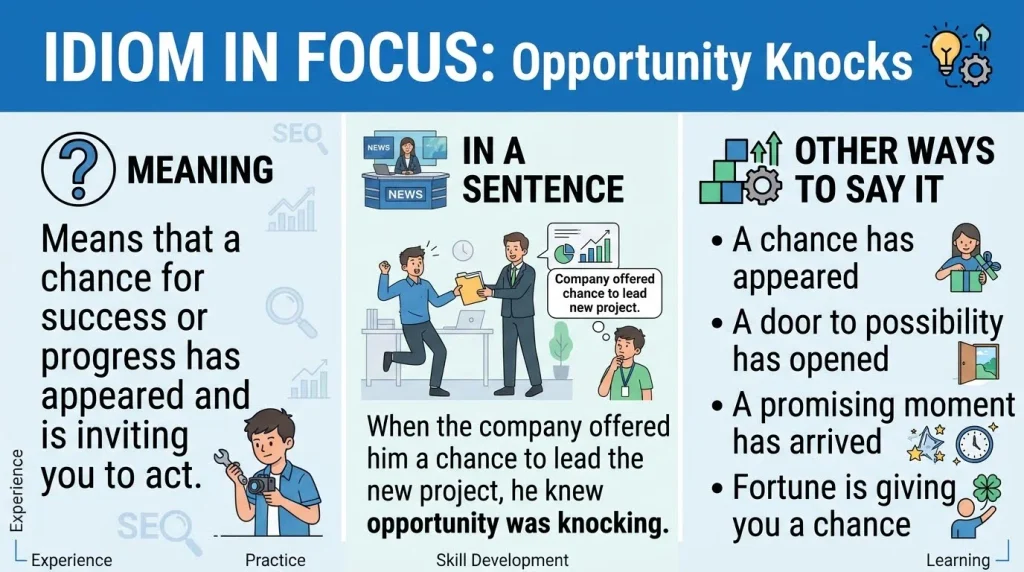
Opportunity knocks means that a chance for success or progress has appeared and is inviting you to act.
In a Sentence
When the company offered him a chance to lead the new project, he knew opportunity was knocking.
Other Ways to Say It
- A chance has appeared
- A door to possibility has opened
- A promising moment has arrived
- Fortune is giving you a chance
Explanation
The expression imagines opportunity as a visitor knocking on your door. You still have to answer; the phrase does not suggest that success happens automatically.
Its conversational tone makes it useful when encouraging someone to recognize a promising possibility.
Best Use
Best for: conversations, motivational messages, storytelling, speeches, and informal writing.
Seize the day
Meaning
Seize the day means to make the most of the present moment instead of waiting indefinitely for a better time.
In a Sentence
She decided to seize the day and submit her proposal rather than wondering whether it was good enough.
Other Ways to Say It
- Make the most of today
- Act while you can
- Take your chance
- Make the moment count
Explanation
This expression focuses less on a particular opportunity and more on the attitude needed to act. It encourages initiative instead of hesitation.
It can sound inspirational or slightly dramatic, so it often has more impact in motivational contexts than in highly formal everyday conversation.
Best Use
Best for: speeches, personal messages, creative writing, motivational posts, and life advice.
Strike while the iron is hot
Meaning
Strike while the iron is hot means to act at the right moment while conditions are favorable.
In a Sentence
Interest in the new product was growing quickly, so the team decided to strike while the iron was hot.
Other Ways to Say It
- Act while conditions are favorable
- Take advantage of the moment
- Move at the right time
- Act before the chance disappears
Explanation
The expression comes from the image of a blacksmith working with hot iron while it is soft enough to shape. The comparison creates a strong sense of timing and urgency.
It is especially effective when hesitation could cause a promising opportunity to disappear.
Best Use
Best for: business discussions, entrepreneurship, advice, speeches, and practical conversations.
Make hay while the sun shines
Meaning
Make hay while the sun shines means to use favorable conditions while they last.
In a Sentence
The tourist season is unusually busy, so local businesses are making hay while the sun shines.
Other Ways to Say It
- Take advantage of good conditions
- Use the opportunity while it lasts
- Make the most of favorable circumstances
- Work while conditions are good
Explanation
The image comes from making hay when the weather is suitable for drying it. The expression connects opportunity with favorable conditions and practical action.
It often sounds folksy or conversational, so it may feel less suitable for highly formal professional writing.
Best Use
Best for: conversations, storytelling, advice, informal articles, and humorous or practical commentary.
Jump at the chance
Meaning
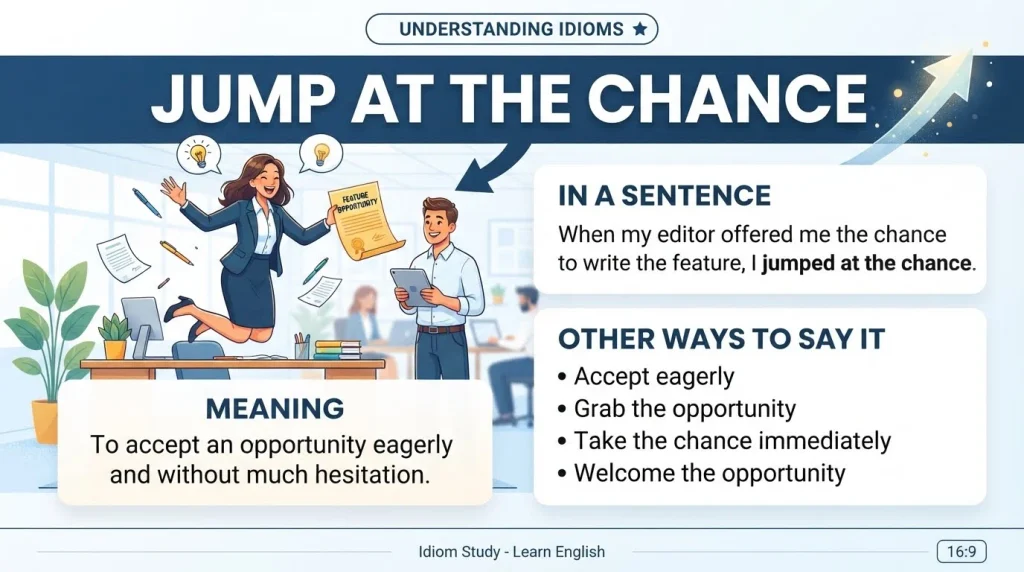
To jump at the chance means to accept an opportunity eagerly and without much hesitation.
In a Sentence
When my editor offered me the chance to write the feature, I jumped at the chance.
Other Ways to Say It
- Accept eagerly
- Grab the opportunity
- Take the chance immediately
- Welcome the opportunity
Explanation
The word “jump” creates an energetic image of someone moving quickly toward a desirable opportunity. It communicates enthusiasm and readiness.
Unlike expressions focused on careful timing, this one emphasizes how strongly someone wants the opportunity.
Best Use
Best for: conversations, personal stories, emails, interviews, social media, and informal writing.
Get a foot in the door
Meaning
To get a foot in the door means to gain an initial opportunity or position that may lead to something better later.
In a Sentence
The internship helped him get a foot in the door at the publishing company.
Other Ways to Say It
- Gain an initial opportunity
- Get an entry point
- Establish a connection
- Get started in a field
Explanation
The image is simple: once your foot is inside a door, it becomes easier to enter completely. The expression therefore describes a first step toward a larger goal.
It is especially useful for discussing careers, networking, industries, organizations, and professional advancement.
Best Use
Best for: career advice, job interviews, business writing, networking conversations, and professional artic
Open doors
Meaning
To open doors means to create new possibilities, opportunities, relationships, or paths to progress.
In a Sentence
Learning another language can open doors to international study and employment.
Other Ways to Say It
- Create new possibilities
- Lead to new opportunities
- Broaden your options
- Make new paths available
Explanation
The expression turns opportunity into the image of doors leading to different destinations. It suggests that one achievement can create several future possibilities.
It is broad and flexible, making it one of the easiest expressions to use when discussing education, skills, relationships, or career development.
Best Use
Best for: essays, speeches, career advice, educational writing, professional conversations, and motivational content.
A stepping stone
Meaning
A stepping stone is an experience, achievement, or opportunity that helps you move toward a larger goal.
In a Sentence
The small local exhibition became a stepping stone toward her goal of showing her work internationally.
Other Ways to Say It
- A useful first step
- A stage in the journey
- A path toward a larger goal
- A foundation for future progress
Explanation
The expression creates an image of stones placed across a stream. Each stone may be small, but it helps you move forward.
It is valuable when an opportunity is not the final destination but provides experience, skills, contacts, or confidence for what comes next.
Best Use
Best for: career writing, education, personal development, essays, interviews, and storytelling.
A springboard
Meaning
A springboard is something that helps launch a person toward a larger opportunity, achievement, or stage of development.
In a Sentence
The community project served as a springboard for his later work in environmental education.
Other Ways to Say It
- A launch point
- A starting platform
- A catalyst for growth
- A foundation for bigger things
Explanation
Unlike a stepping stone, which emphasizes gradual progress, a springboard suggests momentum and upward movement. It creates the image of something giving you the push needed to go farther.
The expression works especially well when one opportunity produces rapid growth or leads to a significantly larger goal.
Best Use
Best for: professional writing, education, business discussions, biographies, and career development.
A blessing in disguise
Meaning
A blessing in disguise is something that initially appears bad or disappointing but eventually produces an unexpected benefit or opportunity.
In a Sentence
Losing that first job turned out to be a blessing in disguise because it pushed him toward a career he enjoyed much more.
Other Ways to Say It
- An unexpected benefit
- A hidden opportunity
- A positive result from a setback
- Something good that came from difficulty
Explanation
This expression is useful when opportunity appears inside disappointment. The “disguise” suggests that the benefit was difficult to recognize at first.
It carries a reflective and hopeful tone, making it especially effective when telling stories about setbacks that eventually led somewhere valuable.
Best Use
Best for: personal stories, motivational writing, conversations, speeches, and reflective essays.
Every cloud has a silver lining
Meaning
Every cloud has a silver lining means that even difficult situations may contain something positive or create an unexpected opportunity.
In a Sentence
Missing the first deadline was frustrating, but every cloud has a silver lining; the extra week gave us time to improve the proposal.
Other Ways to Say It
- There may be something good in the setback
- Look for the positive side
- Difficulties can create possibilities
- Something useful may come from the problem
Explanation
The expression uses the image of a dark cloud edged with sunlight. It does not claim that every problem is secretly good; rather, it encourages people to notice possible benefits within difficult circumstances.
Its familiar, optimistic tone makes it easy to understand.
Best Use
Best for: conversations, encouragement, personal messages, speeches, and reflective writing.
When one door closes, another opens
Meaning
When one door closes, another opens means that when one opportunity disappears, a different possibility may become available.
In a Sentence
Although the fellowship was canceled, when one door closes, another opens, and she soon found a different research opportunity.
Other Ways to Say It
- Another opportunity may appear
- A setback can lead to a new path
- One ending can create a beginning
- A different possibility may emerge
Explanation
The expression turns life’s changes into a series of doors and paths. It encourages flexibility rather than becoming permanently focused on a lost opportunity.
It is hopeful without requiring the original disappointment to be minimized.
Best Use
Best for: personal messages, motivational speeches, essays, storytelling, and discussions about change.
Turn lemons into lemonade
Meaning
To turn lemons into lemonade means to make something positive or useful out of a difficult or disappointing situation.
In a Sentence
The canceled event gave the organizers a chance to create an online program, so they turned lemons into lemonade.
Other Ways to Say It
- Make the best of a bad situation
- Find an opportunity in difficulty
- Turn a setback into progress
- Create something positive from a problem
Explanation
The expression creates a memorable transformation: something sour becomes something sweet. It highlights resourcefulness and positive action rather than simply waiting for circumstances to improve.
It is generally friendly and optimistic, though it can sound too casual when discussing very serious hardship.
Best Use
Best for: conversations, motivational writing, social media, storytelling, and informal speeches.
Take the plunge
Meaning
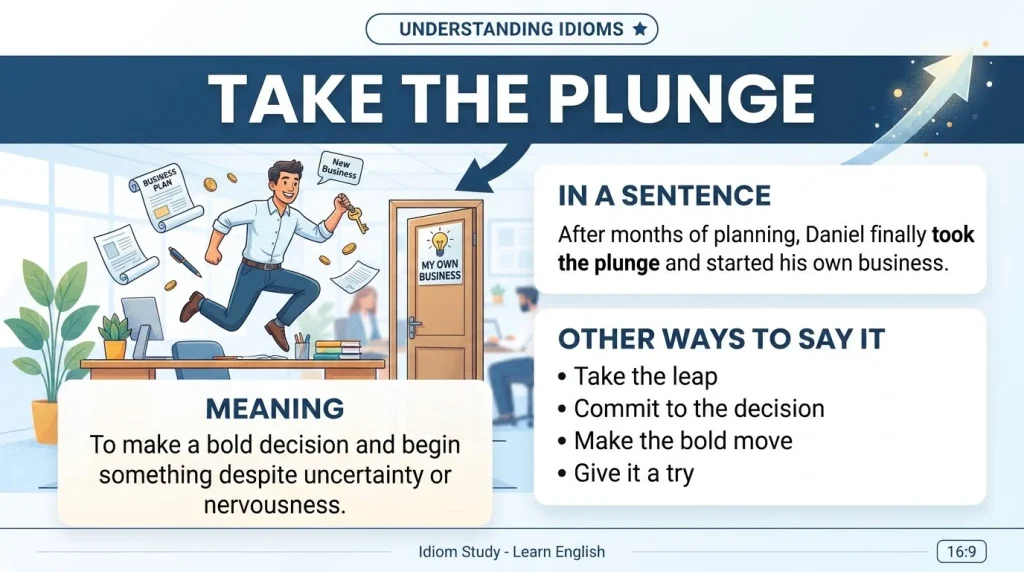
To take the plunge means to make a bold decision and begin something despite uncertainty or nervousness.
In a Sentence
After months of planning, Daniel finally took the plunge and started his own business.
Other Ways to Say It
- Take the leap
- Commit to the decision
- Make the bold move
- Give it a try
Explanation
The image suggests jumping into deep water. You may not know exactly what will happen, but you decide to move forward anyway.
This expression is particularly useful when an opportunity requires courage, commitment, or a willingness to leave familiar ground.
Best Use
Best for: personal stories, career advice, entrepreneurship, conversations, and motivational writing.
Go out on a limb
Meaning
To go out on a limb means to take a risk, especially by supporting an uncertain idea, decision, or possibility.
In a Sentence
I am going out on a limb, but I think this new approach could give the team its biggest opportunity yet.
Other Ways to Say It
- Take a calculated risk
- Risk being wrong
- Make a bold prediction
- Put yourself in an uncertain position
Explanation
The expression creates the image of someone walking onto a tree branch away from the trunk. The farther out you go, the greater the uncertainty.
It is useful when opportunity involves risk as well as potential reward, rather than when success is already almost guaranteed.
Best Use
Best for: conversations, opinion writing, business discussions, predictions, and storytelling.
Put your hat in the ring
Meaning
To put your hat in the ring means to enter a competition, apply for a position, or make it known that you are interested in an opportunity.
In a Sentence
After years of working behind the scenes, she decided to put her hat in the ring for the leadership position.
Other Ways to Say It
- Enter the competition
- Put yourself forward
- Apply for the opportunity
- Express your interest
Explanation
The expression comes from the idea of entering a contest by placing your hat into a ring. It communicates active participation, not merely hoping that an opportunity will come along.
It can sound lively and informal, which makes it more natural in conversation than in highly formal documents.
Best Use
Best for: conversations, elections, competitions, career discussions, opinion pieces, and informal professional writing.
The ball is in your court
Meaning
The ball is in your court means that it is now your responsibility to decide what to do or take the next action.
In a Sentence
We have offered you the position, so the ball is in your court now.
Other Ways to Say It
- The decision is yours
- It is your turn to act
- The next move is yours
- You now have the choice
Explanation
The expression comes from sports, where the ball must be returned from your side of the court. In discussions about opportunity, it emphasizes responsibility and choice.
It works especially well when someone has already been given a chance and must now decide whether to act.
Best Use
Best for: conversations, negotiations, workplace communication, personal messages, and business situations.
A chance of a lifetime
Meaning
A chance of a lifetime describes an unusually important opportunity that may not come again.
In a Sentence
The invitation to perform at the international festival felt like a chance of a lifetime.
Other Ways to Say It
- A once-in-a-lifetime opportunity
- A rare chance
- An extraordinary opportunity
- A moment that may never return
Explanation
This expression gives an opportunity strong emotional weight. It suggests that the moment is rare, significant, and potentially unforgettable.
Because it sounds dramatic, it should be reserved for opportunities that genuinely feel exceptional rather than ordinary everyday chances.
Best Use
Best for: personal stories, speeches, creative writing, promotional content, and emotionally important moments.
Exercise: Practice Using Idioms
Test your understanding of these idioms for opportunity. Choose the best answer for each question.
What does “golden opportunity” mean?
A. A chance involving gold
B. A particularly valuable chance
C. A short period of sunlight
D. A difficult decision
Which expression emphasizes that an opportunity may exist only for a limited time?
A. A springboard
B. Get a foot in the door
C. Window of opportunity
D. Turn lemons into lemonade
What does “opportunity knocks” suggest?
A. A problem has arrived
B. Someone should close a door
C. A visitor needs help
D. A promising chance has appeared
Which idiom encourages someone to make the most of the present moment?
A. Seize the day
B. A stepping stone
C. Go out on a limb
D. Put your hat in the ring
A manager says, “We should strike while the iron is hot.” What does the manager mean?
A. Waiting until circumstances improve
B. Taking action while the situation is in our favor
C. Replacing the tools or machinery
D. Staying away from potentially dangerous choices
Which expression means using favorable circumstances while they last?
A. Make hay while the sun shines
B. The ball is in your court
C. A blessing in disguise
D. Get a foot in the door
If someone “jumps at the chance,” how do they respond to an opportunity?
A. Politely declining the offer
B. Putting off the final choice
C. Enthusiastically agreeing to the proposal
D. Leaving the decision in someone else’s hands
What does “get a foot in the door” usually describe?
A. Making a complete career change
B. Gaining an initial opportunity or entry point
C. Avoiding an important decision
D. Leaving an organization
If a new skill “opens doors,” what does that mean?
A. Opens the door to fresh possibilities
B. Fixes every issue completely
C. Puts an end to previous opportunities
D. Ensures a successful outcome
Which expression describes something that helps you progress toward a larger goal?
A. A chance of a lifetime
B. A stepping stone
C. Opportunity knocks
D. Take the plunge
A difficult event eventually leads to an unexpected benefit. Which expression fits best?
A. Put your hat in the ring
B. The ball is in your court
C. A blessing in disguise
D. Strike while the iron is hot
What does “turn lemons into lemonade” communicate?
A. Avoiding every difficult situation
B. Making something positive from a difficult situation
C. Waiting for another opportunity
D. Taking part in a competition
Someone finally starts a business despite feeling nervous. Which idiom best describes this action?
A. Take the plunge
B. Make hay while the sun shines
C. Open doors
D. Every cloud has a silver lining
What does “put your hat in the ring” mean?
A. Prepare for retirement
B. Enter or apply for an opportunity
C. Give an opportunity to someone else
D. Refuse to compete
If someone says, “The ball is in your court,” what are they communicating?
A. You have lost the opportunity
B. You need to change the rules
C. It is now your responsibility to act or decide
D. The situation is completely finished
Answers
- B — A “golden opportunity” is a particularly valuable or promising chance.
- C — A “window of opportunity” refers to a limited period when something is possible or favorable.
- D — “Opportunity knocks” presents opportunity as a visitor arriving and inviting you to respond.
- A — “Seize the day” encourages someone to make the most of the present moment.
- B — “Strike while the iron is hot” means acting while circumstances are favorable.
- A — “Make hay while the sun shines” means taking advantage of good conditions while they last.
- C — Someone who “jumps at the chance” accepts an opportunity eagerly.
- B — “Get a foot in the door” means gaining an initial position or entry point that can lead to more.
- A — When something “opens doors,” it creates new possibilities or opportunities.
- B — A “stepping stone” is something that helps a person move toward a larger goal.
- C — A “blessing in disguise” is something that initially seems negative but eventually brings an unexpected benefit.
- B — “Turn lemons into lemonade” means making something positive or useful from a difficult situation.
- A — “Take the plunge” means making a bold decision despite uncertainty or nervousness.
- B — “Put your hat in the ring” means entering a competition or putting yourself forward for an opportunity.
- C — “The ball is in your court” means that the other person has made their move and responsibility now rests with you.
FAQs
What is an idiom for opportunity?
An idiom for opportunity is a figurative expression that describes a chance, possibility, opening, or moment for progress. Examples include “golden opportunity,” “window of opportunity,” and “opportunity knocks.”
How do I create my own idiom for opportunity?
Start with a clear image that represents the kind of opportunity you mean. A door can represent access, a bridge can suggest progress, and a window can suggest a temporary opening. Make sure the comparison communicates a clear idea rather than simply replacing one word with another.
What makes an idiom effective?
An effective idiom creates a clear mental image while communicating an idea naturally. It should fit the context and add something that a plain statement may not capture, such as urgency, excitement, risk, hope, or emotional weight.
Can I use these idioms in everyday conversation?
Yes. Expressions such as “jump at the chance,” “get a foot in the door,” and “the ball is in your court” are natural in everyday communication. More dramatic expressions, such as “a chance of a lifetime,” may be better when the opportunity is genuinely significant.
What is the difference between an idiom and a simile?
An idiom is an established expression with a figurative meaning, while a simile directly compares two things using words such as “like” or “as.” For example, “get a foot in the door” is an idiomatic expression, while “the opportunity was like a doorway into a new life” is a simile.
Conclusion
The right idiom can turn the abstract idea of opportunity into something readers can picture and feel. A valuable chance can become a golden opportunity, a limited moment can be a window of opportunity, and a difficult experience can become a blessing in disguise. Other expressions highlight courage, timing, risk, progress, or personal responsibility.
The key is to choose an expression that matches the situation rather than using figurative language simply for decoration. A professional essay may benefit from “window of opportunity,” while a personal story might naturally use “take the plunge.” When the image fits the message, an idiom can make your writing more expressive, memorable, and human. Sometimes, the right words help us recognize an opportunity that was already standing at the door.




[…] Read more:20 Idioms for Opportunity With Real Examples […]