Lonely is more than simply being physically alone. Sometimes a person can feel isolated in a busy room, disconnected from friends, or emotionally distant from people they care about. Idioms give us a vivid way to express these complicated feelings without describing them in plain, repetitive language. Instead of saying someone feels lonely, we can use figurative language that creates a picture in the reader’s mind. Expressions such as “a lone wolf,” “out in the cold,” or “a voice in the wilderness” can communicate different shades of isolation. In this article, you’ll discover 20 useful idioms and idiomatic expressions connected with loneliness, along with meanings, natural examples, alternatives, and guidance on when each expression works best.
What Is a Idiom?
An idiom is an expression whose meaning is different from the literal meaning of the individual words. Idioms are a form of figurative language that make communication more colorful and expressive.
For example, “break the ice” does not usually mean physically breaking ice. It means starting a conversation or making people feel more comfortable. Similarly, “hit the books” means to study seriously rather than literally striking books.
Idioms work because readers and listeners understand the idea behind the image, not just the individual words.
Why Use Idioms for Lonely?
Loneliness can be difficult to explain because it has many forms. Someone may be physically alone, socially excluded, emotionally disconnected, or simply comfortable living independently.
Idioms help express those differences more clearly. They can:
- Give emotions a memorable image.
- Make personal writing more vivid.
- Help explain feelings that are difficult to describe directly.
- Add personality to conversations and storytelling.
- Make poetry, essays, and speeches more expressive.
- Show whether isolation feels painful, peaceful, dramatic, or temporary.
The best expression depends on the kind of loneliness you want to communicate. “A lone wolf,” for example, can suggest independence, while “out in the cold” usually carries a stronger feeling of rejection or exclusion.
Quick List of 20 Idioms
- A lone wolf
- On one’s own
- Out in the cold
- Alone in a crowd
- A voice in the wilderness
- Cast adrift
- Out on a limb
- An island unto oneself
- Fly solo
- Keep to oneself
- The odd one out
- A third wheel
- Cut off from the world
- Left high and dry
- In a world of one’s own
- No one to turn to
- A face in the crowd
- March to the beat of one’s own drum
- All alone in the world
- A solitary figure
A lone wolf
Read more:20 Idioms for Missing With Real Examples
Meaning
A lone wolf describes someone who prefers to act independently and spend time alone rather than being part of a group. The expression can suggest self-reliance, but in some contexts it may also hint at social isolation.
In a Sentence
After years of working alone, Daniel had become something of a lone wolf, rarely joining his colleagues after work.
Other Ways to Say It
- Independent person
- Solitary person
- Someone who prefers their own company
- A person who keeps to themselves
Explanation
The image comes from a wolf separated from its pack. It creates a strong picture of someone moving through life independently rather than relying on a group.
It does not always mean the person is unhappy. In some situations, the expression describes chosen solitude rather than painful loneliness.
Best Use
This expression works especially well in storytelling, character descriptions, conversations, and creative writing.
On one’s own
Meaning
On one’s own means being alone or having to manage without help or companionship. Depending on the context, it can suggest independence or loneliness.
In a Sentence
When her closest friends moved away, Maya suddenly found herself on her own in a city she barely knew.
Other Ways to Say It
- By yourself
- Alone
- Without company
- Without support
Explanation
The expression focuses on being without other people or assistance. Its emotional meaning comes from the surrounding context: being on your own can feel empowering in one situation and deeply lonely in another.
Best Use
It is natural in everyday conversation, personal writing, essays, and storytelling.

Out in the cold
Meaning
To be out in the cold means to be excluded, ignored, or left without the acceptance or support of others. It often carries a strong sense of social rejection.
In a Sentence
After the group stopped inviting him to lunch, he felt as though he had been left out in the cold.
Other Ways to Say It
- Shut out
- Left out
- Excluded
- Pushed aside
Explanation
The expression creates the image of someone standing outside while everyone else is warm and included indoors. That contrast makes it particularly effective for describing loneliness caused by rejection or exclusion.
Best Use
Use it in conversations, personal stories, essays, and emotional narratives.
Alone in a crowd
Meaning
Alone in a crowd describes the feeling of being lonely or disconnected even when surrounded by many people.
In a Sentence
At the huge celebration, surrounded by hundreds of guests, she somehow felt alone in a crowd.
Other Ways to Say It
- Lonely among people
- Surrounded but disconnected
- Isolated in company
- Emotionally alone
Explanation
This expression captures an important kind of loneliness: physical company does not always create emotional connection. The contrast between a crowd and solitude makes the image especially powerful.
Best Use
It fits poetry, reflective writing, personal essays, speeches, and emotional storytelling.
A voice in the wilderness
Meaning
A voice in the wilderness describes someone expressing an important idea or concern without receiving much attention or support from others.
In a Sentence
For years, he felt like a voice in the wilderness, warning about the problem while everyone else ignored him.
Other Ways to Say It
- Speaking without being heard
- An isolated voice
- A lonely advocate
- Speaking into silence
Explanation
The expression creates the image of one voice calling out across an empty wilderness. It can communicate intellectual, emotional, or social isolation, rather than simply being physically alone.
Best Use
It works particularly well in speeches, essays, journalism, storytelling, and serious creative writing.
Cast adrift
Meaning
To be cast adrift means to be left without direction, support, or a dependable connection. It can describe someone who feels emotionally or socially abandoned.
In a Sentence
After losing both his job and his closest friendship, he felt cast adrift with no clear idea of what to do next.
Other Ways to Say It
- Left without support
- Abandoned
- Without direction
- Set loose without guidance
Explanation
The expression comes from the image of something floating away without an anchor or clear destination. That makes it useful for loneliness mixed with uncertainty and abandonment.
Best Use
It is especially effective in novels, memoirs, reflective essays, and dramatic writing.
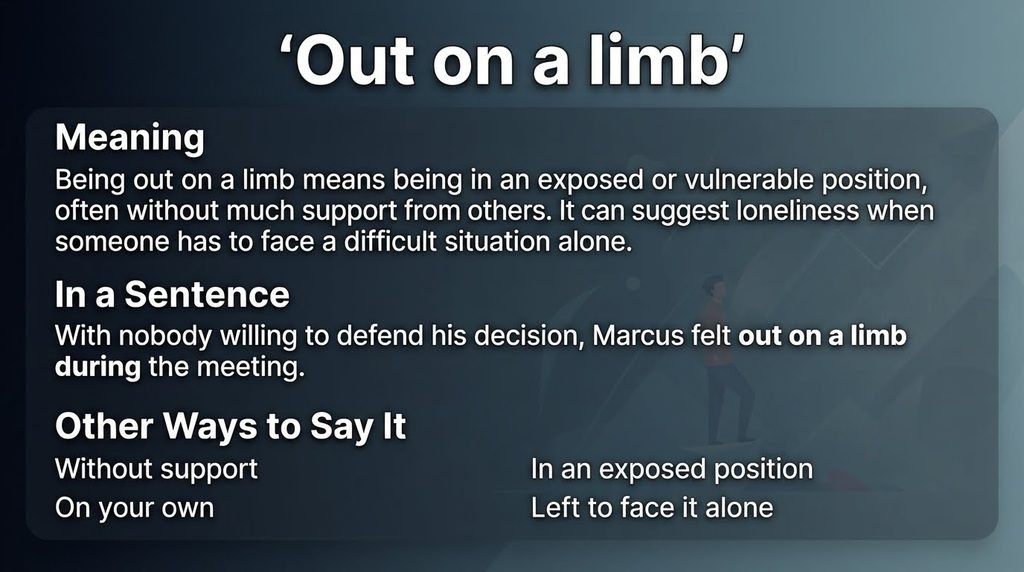
Out on a limb
Meaning
Being out on a limb means being in an exposed or vulnerable position, often without much support from others. It can suggest loneliness when someone has to face a difficult situation alone.
In a Sentence
With nobody willing to defend his decision, Marcus felt out on a limb during the meeting.
Other Ways to Say It
- Without support
- On your own
- In an exposed position
- Left to face it alone
Explanation
The image is of someone sitting far out on a tree branch, separated from the safety of the trunk. It communicates vulnerability and isolation, although loneliness is not its only meaning.
Best Use
Use it in conversations, workplace writing, storytelling, and personal accounts when isolation involves risk or pressure.
An island unto oneself
Meaning
An island unto oneself describes a person who is emotionally or socially separate from others and tends to live independently.
In a Sentence
Since moving to the countryside, he had become an island unto himself, rarely sharing his thoughts with anyone.
Other Ways to Say It
- Completely self-contained
- Socially isolated
- Emotionally distant
- Living separately from others
Explanation
The island image suggests someone surrounded by distance, with no easy bridge connecting them to other people. It can describe deep emotional separation as well as physical solitude.
Best Use
This expression is best suited to literary writing, reflective essays, poetry, and thoughtful descriptions. It can sound somewhat poetic in casual conversation.
Fly solo
Meaning
To fly solo means to do something alone rather than as part of a group. It often emphasizes independence rather than sadness.
In a Sentence
I decided to fly solo and take the weekend trip without waiting for anyone else.
Other Ways to Say It
- Go alone
- Travel alone
- Do it independently
- Go by yourself
Explanation
The expression creates the image of a pilot flying without a partner or crew. Because of that, it usually has a confident and independent tone, although context can make it sound lonely.
Best Use
It works naturally in casual conversation, travel writing, social posts, and personal messages.
Keep to oneself
Meaning
To keep to oneself means to avoid social interaction or spend much of one’s time privately. It does not necessarily mean someone feels lonely.
In a Sentence
Since starting college, Priya has mostly kept to herself, speaking only when she feels comfortable.
Other Ways to Say It
- Stay private
- Avoid socializing
- Spend time alone
- Be reserved
Explanation
This expression focuses on a person’s behavior rather than directly stating their emotions. Someone may keep to themselves because they are shy, peaceful, private, or lonely.
Best Use
It is useful in everyday conversation, character descriptions, essays, and storytelling.
The odd one out
Meaning
The odd one out is the person who seems different from everyone else in a group and therefore may feel excluded or disconnected.
In a Sentence
Everyone else knew each other from school, so I felt like the odd one out at the dinner.
Other Ways to Say It
- The outsider
- The person who doesn’t fit in
- The excluded one
- The misfit
Explanation
The phrase emphasizes not belonging rather than simply being alone. It is especially effective when loneliness comes from feeling different from the people around you.
Best Use
It fits conversation, school writing, personal stories, and character development.
A third wheel
Meaning
A third wheel is someone who feels unnecessary or uncomfortable when spending time with two people who are closely connected, especially a romantic couple.
In a Sentence
I decided to head home because I felt like a third wheel while my two friends talked about their relationship.
Other Ways to Say It
- The extra person
- An unwanted companion
- The outsider
- Someone tagging along
Explanation
The expression compares the extra person to a third wheel on a vehicle, something that seems unnecessary in the usual two-wheel arrangement. It can describe awkward social loneliness rather than complete isolation.
Best Use
It is most natural in casual conversations, personal messages, humorous stories, and social situations.
Cut off from the world
Meaning
To be cut off from the world means to be separated from normal social contact, communication, or outside activity.
In a Sentence
During the storm, the mountain village was cut off from the world for several days.
Other Ways to Say It
- Completely isolated
- Separated from others
- Out of contact
- Disconnected from society
Explanation
This expression creates a broad image of someone or somewhere separated from ordinary life. It can describe physical isolation, social disconnection, or emotional withdrawal.
Best Use
It works well in news-style writing, storytelling, essays, travel descriptions, and dramatic narratives.
Left high and dry
Meaning
To be left high and dry means to be abandoned or left without help when support is needed.
In a Sentence
When everyone else canceled at the last minute, I was left high and dry with no one to help organize the event.
Other Ways to Say It
- Abandoned
- Left without help
- Deserted
- Left without support
Explanation
The phrase suggests being stranded in an inconvenient or helpless position. Loneliness enters the picture when abandonment leaves someone feeling unsupported and alone.
Best Use
Use it in conversation, personal stories, workplace situations, and informal writing.
In a world of one’s own
Meaning
To be in a world of one’s own means to be deeply absorbed in one’s thoughts, imagination, or private experience. It can suggest peaceful solitude or emotional withdrawal.
In a Sentence
He sat by the window, in a world of his own, while everyone else chatted around him.
Other Ways to Say It
- Lost in thought
- In your own little world
- Deep in your thoughts
- Mentally somewhere else
Explanation
Unlike expressions that strongly imply rejection, this one can feel gentle and neutral. The person may be lonely, but they may also simply be enjoying private thoughts.
Best Use
It works especially well in creative writing, character descriptions, poetry, and everyday conversation.
No one to turn to
Meaning
Having no one to turn to means having nobody available for emotional support, advice, or practical help.
In a Sentence
When everything went wrong at once, she felt she had no one to turn to.
Other Ways to Say It
- Without anyone to rely on
- Without support
- With nobody for help
- Completely unsupported
Explanation
This expression is direct but still figurative in its idea of “turning” toward someone for help. It captures emotional loneliness and helplessness particularly well.
Best Use
It is suitable for personal writing, conversations, serious storytelling, speeches, and reflective essays.
A face in the crowd
Meaning
A face in the crowd describes someone who is present among many people but remains unnoticed or personally disconnected.
In a Sentence
At the conference, I was just a face in the crowd, surrounded by strangers who had never heard of me.
Other Ways to Say It
- An unnoticed person
- One among many
- An anonymous individual
- Lost among people
Explanation
The expression contrasts visibility with recognition. Someone can be surrounded by people and still feel anonymous and emotionally invisible.
Best Use
It works particularly well in poetry, fiction, speeches, reflective writing, and social commentary.
March to the beat of one’s own drum
Meaning
To march to the beat of one’s own drum means to live, think, or act according to one’s own ideas rather than following the crowd.
In a Sentence
She has always marched to the beat of her own drum, choosing an unusual career path despite her family’s expectations.
Other Ways to Say It
- Do things your own way
- Follow your own path
- Think independently
- Refuse to follow the crowd
Explanation
This expression is mainly about individuality, not loneliness. However, choosing a different path can sometimes leave a person feeling separate from those around them.
Best Use
It is effective in motivational writing, biographies, speeches, social posts, and character descriptions.
All alone in the world
Meaning
All alone in the world is a strongly emotional expression suggesting that someone feels completely without companionship, family, or meaningful support.
In a Sentence
After moving to a new country without knowing anyone, he sometimes felt all alone in the world.
Other Ways to Say It
- Completely alone
- Without anyone
- Utterly isolated
- With nobody beside you
Explanation
The phrase magnifies loneliness by making the entire world feel empty of meaningful connections. It is dramatic and emotional, so it should be used when the feeling is genuinely intense.
Best Use
It works best in poetry, fiction, memoirs, emotional speeches, and personal reflections.

A solitary figure
Meaning
A solitary figure describes one person standing or moving alone, often creating an image of separation from other people.
In a Sentence
A solitary figure stood at the edge of the beach long after the other visitors had gone home.
Other Ways to Say It
- A person standing alone
- A lone person
- An isolated individual
- A solitary person
Explanation
This expression is more descriptive and literary than conversational. It creates a visual scene and lets the reader infer the person’s emotional state rather than stating that they are lonely.
Best Use
It is particularly effective in fiction, poetry, photography captions, descriptive essays, and atmospheric writing.
Exercise: Practice Using Idioms
1. What does “a lone wolf” usually describe?
A. A person employed alongside many coworkers
B. An individual who likes working independently
C. A person with no affection for animals
D. An individual who goes on trips with companions
2. Which expression best describes feeling lonely despite being surrounded by people?
A. Fly solo
B. Keep to oneself
C. Alone in a crowd
D. March to the beat of one’s own drum
3. If someone is “out in the cold,” what does the expression usually suggest?
A. Experiencing extremely low temperatures
B. Getting ready for the cold season
C. Spending time outdoors in pleasant conditions
D. Facing rejection or being left out
4. What does “cast adrift” suggest?
A. Being left without support or direction
B. Joining a large group
C. Becoming more organized
D. Finding a permanent home
5. Which expression is most closely associated with feeling like you do not belong in a group?
A. Fly solo
B. The odd one out
C. In a world of one’s own
D. On one’s own
6. What does “a third wheel” usually describe?
A. A person traveling alone
B. Someone who works independently
C. An extra person with a closely connected pair
D. A person who has no friends at all
7. Which expression can describe someone who is isolated but not necessarily unhappy?
A. A lone wolf
B. Left high and dry
C. No one to turn to
D. Out in the cold
8. What does “a voice in the wilderness” suggest?
A. Speaking loudly at a concert
B. Communicating an idea without being heard or supported
C. Talking to animals
D. Giving directions outdoors
9. Which expression focuses most strongly on having nobody available for support?
A. A face in the crowd
B. Fly solo
C. No one to turn to
D. Keep to oneself
10. What does “a face in the crowd” emphasize?
A. Remaining unnoticed within a large crowd
B. Taking charge of a team or organization
C. Suffering an injury to the body
D. Receiving an invitation to a special event
11. Which expression is most likely to sound poetic or literary?
A. On one’s own
B. A solitary figure
C. Fly solo
D. Keep to oneself
12. If someone “keeps to themselves,” what does it mean?
A. Frequently looking for crowded places
B. Refusing to share personal things with others
C. Preferring privacy and limited social contact
D. Choosing to travel without companions
13. Which expression can suggest vulnerability because someone lacks support?
A. Out on a limb
B. In a world of one’s own
C. A face in the crowd
D. Fly solo
14. Which sentence uses “left high and dry” correctly?
A. The flowers were left high and dry after being watered.
B. I was left high and dry when my helper canceled at the last moment.
C. She left high and dry because she enjoyed the sunshine.
D. The swimmer felt high and dry in the deep pool.
15. Which expression is mainly about individuality rather than loneliness?
A. All alone in the world
B. No one to turn to
C. March to the beat of one’s own drum
D. Cut off from the world
Answers
- B — “A lone wolf” commonly describes someone who prefers to act independently rather than as part of a group.
- C — “Alone in a crowd” captures the contrast between being physically surrounded by people and feeling emotionally isolated.
- D — Being “out in the cold” commonly means being excluded, ignored, or denied support.
- A — “Cast adrift” suggests being left without support, direction, or a dependable connection.
- B — “The odd one out” describes someone who feels different from or excluded by a group.
- C — A “third wheel” is an extra person in a situation involving two closely connected people, especially a couple.
- A — “A lone wolf” can describe chosen independence and does not necessarily imply unhappiness.
- B — “A voice in the wilderness” refers to someone whose message receives little attention or support.
- C — “No one to turn to” directly expresses the absence of someone who can provide help or emotional support.
- A — “A face in the crowd” suggests anonymity or being unnoticed among many people.
- B — “A solitary figure” has a strongly descriptive and literary quality, making it suitable for atmospheric writing.
- C — Someone who keeps to themselves generally prefers privacy or limited social interaction.
- A — “Out on a limb” suggests being exposed or vulnerable without much support.
- B — “Left high and dry” means being abandoned or left without expected help.
- C — “March to the beat of one’s own drum” primarily describes independence and individuality rather than loneliness.
FAQs
What is an idiom for lonely?
Several expressions can describe loneliness depending on the situation. “Alone in a crowd” works well for emotional loneliness among people, while “no one to turn to” emphasizes a lack of support. “A lone wolf” is better for someone who prefers independence.
How do I create my own idiom for loneliness?
Start with a clear image that represents the feeling. Think about situations such as an empty chair, a distant shore, a closed door, or a voice that nobody answers. Then connect that image to the emotional experience without making the comparison too literal.
What makes an idiom effective?
A strong idiom creates a clear mental picture while communicating an idea beyond the literal words. It should feel natural, easy to understand from context, and appropriate for the tone of the situation.
Can I use these idioms in everyday conversation?
Yes, many can. Expressions such as “on one’s own,” “fly solo,” “keep to oneself,” “the odd one out,” and “a third wheel” are natural in everyday speech. More literary expressions, such as “a solitary figure,” may work better in writing.
What is the difference between an idiom and a simile?
An idiom is an established expression whose meaning is not fully understood from its literal words, such as “out in the cold.” A simile directly compares two things using words such as “like” or “as,” such as “lonely like a lighthouse on an empty shore.”
Conclusion
Loneliness can be quiet, painful, peaceful, social, emotional, or temporary, so one expression cannot capture every experience. The idioms and idiomatic expressions in this guide give you different ways to describe those shades of isolation. “A lone wolf” can suggest independence, while “out in the cold” communicates exclusion. “Alone in a crowd” captures emotional disconnection, whereas “no one to turn to” highlights the absence of support.
When choosing an expression, think about the feeling you actually want your reader or listener to understand. The strongest figurative language does more than sound interesting it creates an image that makes an emotion easier to recognize. Sometimes, describing loneliness through a simple image can make an otherwise difficult feeling feel less alone.

Margaret Saywell is an English author and editor who has spent more than fifteen years working with words teaching, proofreading, and writing about the quirks of the English language.
At Idiom Looms, Margaret gathers idioms from across the English-speaking world and weaves them into clear, practical guides. She loves digging into the history of a phrase and showing readers how a few well-chosen words can say far more than a long explanation.
She believes language should be enjoyed, not feared and that the best way to learn an idiom is to see it in action.