
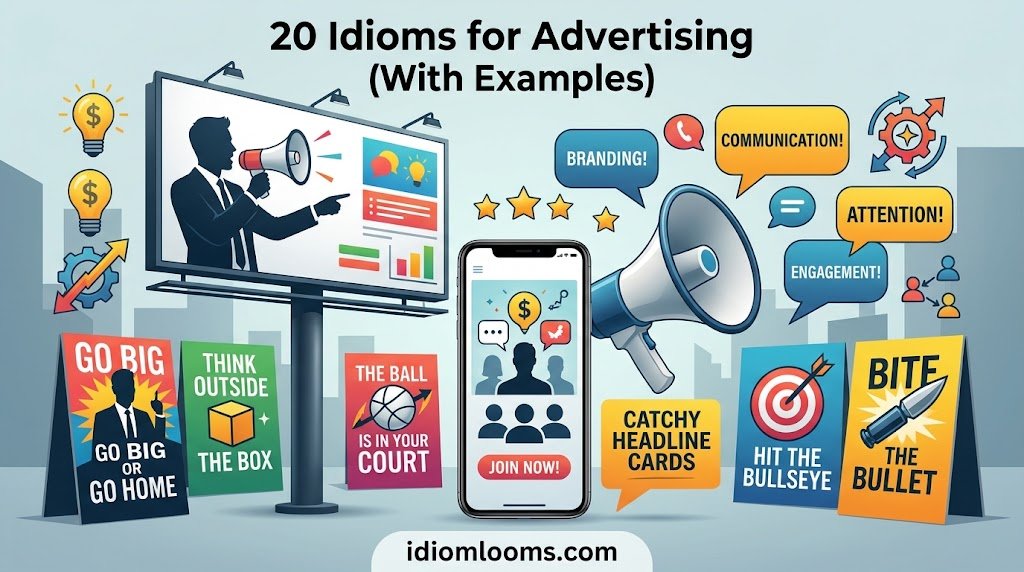
Have you noticed how the right phrase can make an advertisement instantly memorable? 20 Idioms for Advertising With Real Examples explores expressive phrases that help marketers communicate ideas with clarity and personality. These idioms can make advertising language, brand messaging, and business communication more engaging without sounding forced.
Whether you write campaigns, manage scheduling, coordinate meetings, or handle project management, strong language improves everyday communication. Idioms also appear in broadcasting, online booking, and promotional content, where concise wording matters. Understanding their English usage, grammar, and meaning helps you choose expressions that fit each message naturally.
This article introduces 20 useful idioms connected with advertising, promotion, persuasion, and creative communication. Each expression includes a clear meaning, a realistic example, alternative phrases, and practical context. You will also see how idioms can support formal writing, marketing conversations, and consistent messaging. With attention to consistency and context, you can use figurative language more confidently.
What Is a Idiom?
An idiom is a fixed or familiar expression whose overall meaning cannot always be understood by taking every word literally.
For example, “break the ice” does not usually mean physically breaking ice. It means to make people feel more comfortable in a new or awkward situation.
Another example is “hit the nail on the head.” Literally, it describes striking a nail correctly with a hammer. Figuratively, it means to identify or describe something exactly.
Idioms are different from literal statements because their meaning often depends on figurative language, shared understanding, and context. In advertising, this makes them useful for expressing ideas in a more colorful and memorable way.
Why Use Idioms for Advertising?
Advertising often has very little time to make an impression. A short phrase needs to communicate an idea quickly while also giving the audience something memorable.
Idioms can help advertising language:
- Express excitement or emotion without lengthy explanations.
- Make a campaign sound more natural and conversational.
- Turn an abstract marketing idea into a clear mental image.
- Give promotional writing more personality and energy.
- Make presentations and campaign descriptions easier to remember.
- Add variety to advertising copy and creative writing.
- Explain goals such as attention, awareness, popularity, and promotion simply.
- Create a tone that feels playful, persuasive, dramatic, or inspirational, depending on the expression.
The key is context. An idiom that works beautifully in a creative campaign may sound too casual in a formal business report. Strong advertising language is not only memorable; it is also appropriate for its audience.
Quick List of 20 Idioms
- Get the word out
- Spread the word
- Catch someone’s eye
- Make a splash
- Steal the show
- Raise eyebrows
- Sing your praises
- Put your best foot forward
- Hit the nail on the head
- Cut through the noise
- In the spotlight
- Front and center
- A picture is worth a thousand words
- Word of mouth
- On everyone’s lips
- Ring a bell
- Get the ball rolling
- Go the extra mile
- Leave a mark
- Break the ice
Get the Word Out
Read more:20 Idioms for Adults With Real Examples
Meaning
“Get the word out” means to make sure that people receive or hear important information. For advertising, it represents the basic goal of spreading awareness about a product, service, event, or campaign.
In a Sentence
The new campaign helped the small business get the word out about its weekend promotion.
Other Ways to Say It
- Spread the message
- Raise awareness
- Tell people about it
- Get the message across
Explanation
This expression creates an image of information moving from one person to another until a wider audience knows about it. It works particularly well when discussing launches, promotions, announcements, and awareness campaigns.
Unlike highly poetic expressions, this one sounds natural in everyday marketing conversations. It can describe both traditional advertising and informal promotional efforts.
Best Use
Business conversations, marketing presentations, campaign planning, social media, and casual advertising discussions.
Spread the Word
Meaning
“Spread the word” means to tell other people about something so that the information reaches a larger audience. In advertising, it highlights sharing and expanding awareness.
In a Sentence
Customers were encouraged to spread the word about the brand’s new community event.
Other Ways to Say It
- Tell others
- Share the news
- Pass the message along
- Help people hear about it
Explanation
The expression suggests information traveling outward through a network of people. That makes it especially useful when advertising depends on sharing, referrals, recommendations, or social conversation.
It has a friendly, approachable tone, so it can make promotional language feel less formal and more personal.
Best Use
Social media posts, community campaigns, event promotion, newsletters, and conversational marketing copy.

Catch Someone’s Eye
Meaning
“Catch someone’s eye” means to attract someone’s attention. In advertising, it describes a visual, headline, product, or design that makes people stop and look.
In a Sentence
The bold packaging was designed to catch shoppers’ eyes on a crowded store shelf.
Other Ways to Say It
- Grab attention
- Attract attention
- Stand out
- Draw the eye
Explanation
This idiom creates a simple visual image: something suddenly becomes noticeable among everything else around it. That is closely connected to the first challenge of many advertisements—getting noticed.
It is especially effective when discussing colors, headlines, packaging, posters, signs, displays, or visual campaigns. It is more conversational than technical.
Best Use
Advertising copy, design discussions, product descriptions, creative briefs, and presentations.
Make a Splash
Meaning
“Make a splash” means to attract a lot of attention or create a strong impression, often when something is newly introduced.
In a Sentence
The company made a splash with a surprising launch campaign that appeared across the city.
Other Ways to Say It
- Make a strong impression
- Create excitement
- Make an impact
- Attract attention
Explanation
The expression comes from the image of something hitting water and sending it outward in every direction. In advertising, that image suggests a campaign that creates noticeable excitement rather than quietly entering the market.
It has an energetic and slightly dramatic tone. It works well for launches and creative campaigns but may feel too informal for a highly technical report.
Best Use
Campaign launches, creative advertising, promotional events, social media, and storytelling.
Steal the Show
Meaning
“Steal the show” means to attract more attention than everything else in the situation. In advertising, it can describe a product, advertisement, visual, slogan, or campaign that becomes the main attraction.
In a Sentence
The playful mascot stole the show and became the most memorable part of the campaign.
Other Ways to Say It
- Become the main attraction
- Get all the attention
- Stand out from the rest
- Take center stage
Explanation
The expression creates the image of a performance in which one person unexpectedly becomes the audience’s favorite. Applied to advertising, it suggests that one creative element has become more memorable than competing messages.
Because it has a lively, dramatic flavor, it is usually better suited to creative or conversational contexts than formal reports.
Best Use
Creative writing, campaign reviews, presentations, advertising discussions, and promotional storytelling.
Raise Eyebrows
Meaning
“Raise eyebrows” means to cause surprise, curiosity, concern, or mild shock. In advertising, it can describe a campaign that makes people notice and react.
In a Sentence
The unusual billboard design raised eyebrows but also generated plenty of conversation.
Other Ways to Say It
- Cause a stir
- Surprise people
- Get people talking
- Attract attention
Explanation
Raised eyebrows are a natural visual sign of surprise. The idiom turns that physical reaction into a figurative description of an advertisement that produces a strong response.
Importantly, the reaction is not always positive. An advertisement can raise eyebrows because it is bold, controversial, unexpected, or unusual. That nuance makes this expression useful when discussing attention-grabbing campaigns.
Best Use
Advertising analysis, campaign reviews, opinion writing, journalism, and creative discussions.
Sing Your Praises
Meaning
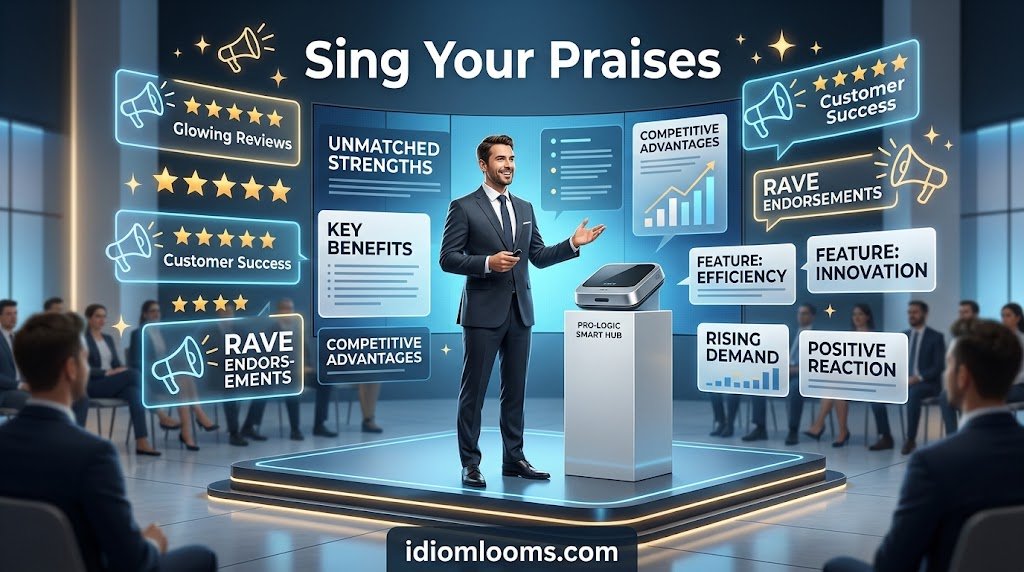
“Sing your praises” means to speak enthusiastically about someone’s qualities, achievements, or value. In advertising, it can describe promoting a product’s strengths.
In a Sentence
The campaign sang the product’s praises by highlighting its simple design and long-lasting performance.
Other Ways to Say It
- Highlight its strengths
- Praise its benefits
- Promote its advantages
- Speak highly of it
Explanation
The word “sing” gives ordinary praise a musical and expressive image. Instead of simply listing benefits, the phrase suggests enthusiastic appreciation.
It is useful when talking about promotional language that emphasizes what makes a brand or product appealing. Because the expression is somewhat playful, it is more natural in informal or creative contexts than in highly formal technical writing.
Best Use
Creative advertising copy, product storytelling, blog writing, campaign commentary, and informal presentations.
Put Your Best Foot Forward
Meaning
“Put your best foot forward” means to present yourself or something in the best possible way. In advertising, it refers to showing a product, brand, or business at its strongest.
In a Sentence
The company put its best foot forward by leading the campaign with its most useful customer benefits.
Other Ways to Say It
- Present your best side
- Make a strong first impression
- Highlight your strengths
- Show what you do best
Explanation
The expression comes from the idea of taking a confident first step. In advertising, it fits situations where a brand has limited space or time and needs to emphasize its strongest qualities first.
It has a positive and encouraging tone. It can also describe a broader branding strategy rather than one specific advertisement.
Best Use
Brand introductions, promotional campaigns, presentations, business writing, and product launches.
Hit the Nail on the Head
Meaning
“Hit the nail on the head” means to describe, identify, or solve something exactly right. In advertising, it can describe a campaign that understands its audience or message perfectly.
In a Sentence
The new slogan hit the nail on the head by expressing exactly what customers wanted from the service.
Other Ways to Say It
- Get it exactly right
- Identify the key point
- Nail the message
- Be right on target
Explanation
The literal image is simple: a hammer strikes the nail directly in the right place. Figuratively, the expression represents precision and accuracy.
It is especially useful when discussing a successful slogan, audience insight, marketing message, or creative decision. Unlike expressions focused only on attention, this one emphasizes getting the message right.
Best Use
Marketing analysis, presentations, advertising strategy, business conversations, and campaign reviews.
Cut Through the Noise
Meaning
“Cut through the noise” means to get attention or communicate clearly despite a large amount of competing information. In advertising, it represents standing out in a crowded communication environment.
In a Sentence
The simple headline helped the campaign cut through the noise on a busy social media feed.
Other Ways to Say It
- Stand out in the crowd
- Break through the clutter
- Get noticed
- Rise above distractions
Explanation
The metaphor compares competing messages to a wall of loud, confusing noise. An effective advertisement “cuts through” that noise by delivering a message that people can notice and understand.
This expression has a modern marketing feel, although it is still figurative language. It is particularly useful when discussing competition for attention.
Best Use
Marketing strategy, professional presentations, advertising analysis, creative briefs, and business writing.
In the Spotlight
Meaning
“In the spotlight” means receiving a great deal of public attention. For advertising, it can describe a brand, product, campaign, or message that has become highly visible.
In a Sentence
After the campaign went viral, the previously unknown product was suddenly in the spotlight.
Other Ways to Say It
- In the public eye
- Receiving attention
- At center stage
- Under public attention
Explanation
The phrase comes from stage lighting, where a spotlight focuses attention on a performer. Applied to advertising, it creates an image of one brand or campaign being clearly visible among many others.
The expression can be positive or neutral, depending on context. A product can be in the spotlight because of successful promotion, public discussion, or controversy.
Best Use
Advertising articles, campaign analysis, press coverage, presentations, and storytelling.
Front and Center
Meaning
“Front and center” means placed in the most noticeable or important position. In advertising, it describes putting a key message, product, benefit, or brand element where people will notice it immediately.
In a Sentence
The campaign placed the limited-time offer front and center on every promotional poster.
Other Ways to Say It
- In a prominent position
- Clearly visible
- At the forefront
- In the most noticeable place
Explanation
The expression creates a strong spatial image: something is positioned directly where attention naturally goes. In advertising, that can refer to a headline, product, call to action, logo, or major selling point.
It is practical and conversational rather than poetic, making it useful when discussing layout, messaging, or promotional priorities.
Best Use
Design discussions, advertising strategy, campaign planning, presentations, and copywriting.
A Picture Is Worth a Thousand Words
Meaning
“A picture is worth a thousand words” means that an image can communicate an idea or feeling more effectively than a long verbal explanation.
In a Sentence
For the travel campaign, the creative team believed a picture was worth a thousand words, so the advertisement focused on a striking destination photograph.
Other Ways to Say It
- Images can speak for themselves
- Show, don’t just tell
- A strong image says a lot
- Visuals can communicate quickly
Explanation
The expression emphasizes the power of visual communication. Advertising often uses images to show a product’s appearance, atmosphere, benefits, or emotional appeal without explaining everything in text.
This is especially appropriate for visual campaigns, although it should not be treated as a rule that images are always better than words. Strong advertising often depends on the two working together.
Best Use
Visual advertising, photography, packaging, posters, social media, creative writing, and design presentations.
Word of Mouth
Meaning
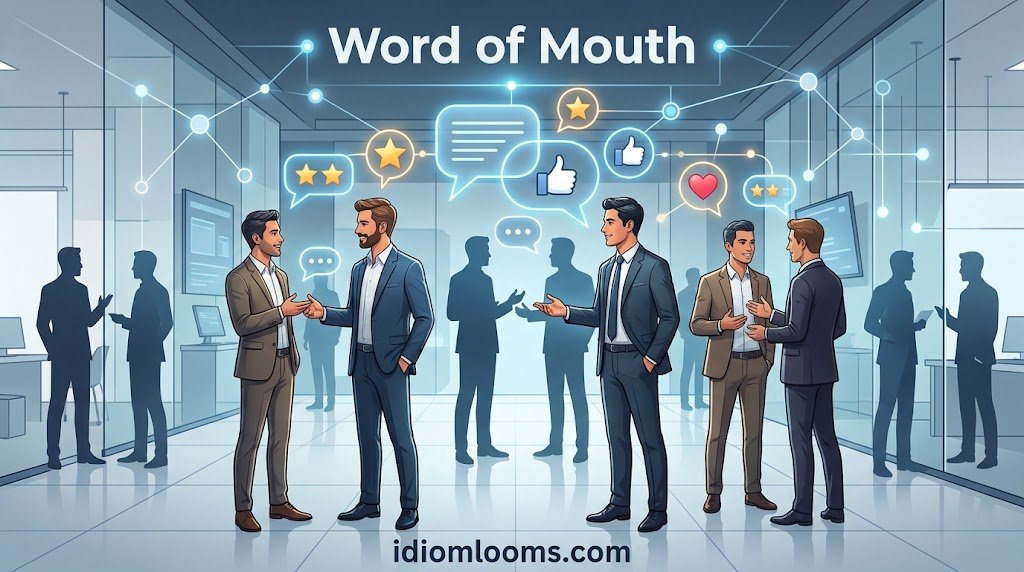
“Word of mouth” refers to people sharing information, opinions, or recommendations with one another through personal communication. In advertising, it represents organic discussion and personal recommendation.
In a Sentence
The restaurant attracted new customers largely through word of mouth from satisfied visitors.
Other Ways to Say It
- Personal recommendations
- Customer referrals
- People telling others
- Personal sharing
Explanation
The phrase creates an image of information traveling through ordinary human conversation rather than only through paid promotional channels.
It is useful when discussing reputation, referrals, recommendations, and customer conversations. It also highlights an important distinction: word of mouth is not necessarily the same thing as paid advertising.
Best Use
Marketing discussions, business writing, customer testimonials, campaign analysis, and conversations about brand reputation.
On Everyone’s Lips
Meaning
“On everyone’s lips” means that something is being talked about by many people. In advertising, it can describe a campaign, brand, product, or slogan that has become a major topic of conversation.
In a Sentence
After the memorable launch, the brand’s new slogan was on everyone’s lips.
Other Ways to Say It
- Everyone is talking about it
- A topic of conversation
- Widely discussed
- The talk of the town
Explanation
The expression uses the lips as a symbol of speech and conversation. It suggests that an idea has moved beyond paid advertising and entered everyday discussion.
It is more expressive than “widely discussed,” which gives it a warmer and more dramatic feel. However, it can sound exaggerated if very few people are actually talking about the subject.
Best Use
Creative writing, campaign storytelling, promotional copy, magazine-style writing, and informal advertising commentary.
Ring a Bell
Meaning
“Ring a bell” means that something seems familiar or reminds someone of something they have encountered before. In advertising, it can describe a name, slogan, image, or message that feels familiar to an audience.
In a Sentence
The old slogan may still ring a bell with customers who remember the brand from childhood.
Other Ways to Say It
- Seem familiar
- Trigger a memory
- Sound familiar
- Bring something to mind
Explanation
The phrase creates the image of a bell sounding when something suddenly becomes recognizable. In advertising, that can be useful when discussing brand familiarity, recognition, nostalgia, or remembered slogans.
It does not necessarily mean that someone remembers everything about a brand. The feeling can be as simple as, “I know that name from somewhere.”
Best Use
Brand storytelling, nostalgia campaigns, advertising analysis, customer research discussions, and informal presentations.
Get the Ball Rolling
Meaning
“Get the ball rolling” means to start an activity, process, or conversation. In advertising, it can describe launching a campaign or beginning promotional activity.
In a Sentence
The teaser advertisement was designed to get the ball rolling before the full campaign launched.
Other Ways to Say It
- Get things started
- Begin the campaign
- Start the process
- Set things in motion
Explanation
The expression comes from the image of a ball beginning to move. Once it starts rolling, the activity can continue and build momentum.
That makes it particularly suitable for early campaign activity such as teaser advertisements, announcements, introductory posts, or initial promotions. Its tone is casual and energetic.
Best Use
Campaign planning, meetings, presentations, social media, and informal marketing conversations.
Go the Extra Mile
Meaning
“Go the extra mile” means to make an additional effort beyond what is normally expected. In advertising, it can describe a brand or campaign that adds extra care, creativity, or value.
In a Sentence
The creative team went the extra mile by developing several versions of the advertisement for different audiences.
Other Ways to Say It
- Make an extra effort
- Do more than expected
- Add extra value
- Put in additional effort
Explanation
The expression suggests continuing farther than the minimum required distance. In advertising, it can represent extra attention to detail, stronger creative work, thoughtful customer communication, or additional campaign support.
It is useful when praising effort, but it should not be used as a substitute for explaining what that extra effort actually involved.
Best Use
Business writing, campaign reviews, team discussions, customer-focused marketing, and professional presentations.
Leave a Mark
Meaning
“Leave a mark” means to make a lasting impression or have an effect that people remember. In advertising, it can describe a campaign that stays in the audience’s memory.
In a Sentence
The campaign’s unusual storytelling left a mark long after the advertisement had stopped running.
Other Ways to Say It
- Make a lasting impression
- Stay in people’s minds
- Be memorable
- Have a lasting effect
Explanation
The metaphor suggests a physical mark that remains after something has passed. In advertising, that becomes a picture of memory and lasting impact.
This expression is broader than simply “get attention.” An advertisement may catch someone’s eye for a moment without leaving a lasting impression. “Leave a mark” focuses on what remains afterward.
Best Use
Brand storytelling, advertising analysis, speeches, creative writing, campaign reviews, and reflective marketing content.
Break the Ice
Meaning
“Break the ice” means to make people feel more comfortable and begin interaction in a situation that might otherwise feel awkward or unfamiliar.
In a Sentence
The playful advertisement helped the new brand break the ice with an audience that did not know it yet.
Other Ways to Say It
- Start a conversation
- Create a friendly introduction
- Put people at ease
- Open the conversation
Explanation
The literal image suggests breaking through a layer of ice that separates people. Figuratively, it represents removing social tension and creating an opening for communication.
In advertising, this can work especially well for brands entering a new market or speaking to an unfamiliar audience. It is not primarily about selling; it is about creating a welcoming first connection.
Best Use
Brand introductions, humorous advertising, social media campaigns, storytelling, community marketing, and presentations.
Exercise: Practice Using Idioms
Test your understanding of advertising-related idioms with these 15 questions.
1. What does “get the word out” mean in an advertising context?
A. Remove unnecessary text
B. Make information known to more people
C. Rewrite a product description
D. Stop a promotional campaign
2. An advertisement designed to “catch someone’s eye” is intended to:
A. Explain a complicated policy
B. Reduce the price of a product
C. Attract someone’s attention
D. End a conversation
3. What does “make a splash” suggest about a campaign?
A. It attracts considerable excitement or public interest
B. This expression relies exclusively on water-related imagery
C. The phrase keeps it away from public notice
D. Its reach is limited to a tiny audience
4. If a campaign “hit the nail on the head,” what did it probably do?
A. Spend very little money
B. Use a traditional slogan
C. Avoid making a clear point
D. Express the key idea accurately
5. Which situation best fits “raise eyebrows”?
A. An advertisement quietly runs for several months
B. A surprising campaign causes people to react
C. A company removes an old logo
D. A designer corrects a spelling mistake
6. What does “cut through the noise” mean in advertising?
A. Make an advertisement quieter
B. Remove all background music
C. Get noticed despite competing messages
D. Replace a campaign with a new one
7. If a product is “in the spotlight,” it is:
A. Receiving significant attention
B. Being hidden from customers
C. No longer available
D. Being sold without advertising
8. Which expression focuses most directly on visual communication?
A. Go the extra mile
B. Get the ball rolling
C. Word of mouth
D. A picture is worth a thousand words
9. What does “word of mouth” describe?
A. A printed advertisement
B. People sharing information or recommendations personally
C. A company changing its slogan
D. A product displayed in a shop window
10. If an old brand name “rings a bell,” what does that usually mean?
A. Nobody has encountered it before
B. Its popularity has declined
C. Someone recognizes it from past experience
D. Television commercials are promoting it
11. Which expression best describes putting the strongest message in a highly visible position?
A. Front and center
B. Break the ice
C. Raise eyebrows
D. Sing your praises
12. A company that “goes the extra mile” is making:
A. A mistake in its advertising
B. An unusually large number of advertisements
C. An additional effort beyond what is expected
D. A decision to stop marketing
13. Which expression suggests that an advertisement or campaign has created a lasting impression?
A. Get the word out
B. Leave a mark
C. Spread the word
D. Get the ball rolling
14. Which sentence uses “break the ice” correctly?
A. The company broke the ice by deleting its advertisement.
B. The new campaign broke the ice by giving unfamiliar customers a friendly introduction.
C. The designer broke the ice by changing the font size.
D. The product broke the ice because it was stored in a freezer.
15. Which idiom best describes a campaign that becomes the main attraction among many competing advertisements?
A. Put your best foot forward
B. Ring a bell
C. Steal the show
D. Word of mouth
Answers
- B — “Get the word out” means to make information known or reach a wider audience.
- C — “Catch someone’s eye” means to attract attention, often through a visual or noticeable feature.
- A — “Make a splash” describes creating strong attention, excitement, or impact.
- D — “Hit the nail on the head” means to identify or express something exactly right.
- B — “Raise eyebrows” means to cause surprise, curiosity, concern, or another noticeable reaction.
- C — “Cut through the noise” means to stand out despite competing information or distractions.
- A — Being “in the spotlight” means receiving substantial attention or visibility.
- D — “A picture is worth a thousand words” emphasizes the communication power of images.
- B — “Word of mouth” refers to people sharing information or recommendations through personal communication.
- C — If something “rings a bell,” it feels familiar or triggers a memory.
- A — “Front and center” means placed in a prominent or highly noticeable position.
- C — “Go the extra mile” means making additional effort beyond what is normally expected.
- B — “Leave a mark” focuses on creating a lasting impression or effect.
- B — “Break the ice” means making an unfamiliar or potentially awkward interaction more comfortable.
- C — “Steal the show” describes something that attracts more attention than everything else around it.
FAQs
What is an idiom for advertising?
An advertising idiom is a familiar figurative expression that can help describe promotion, attention, communication, audience response, or brand impact. Examples include “get the word out,” “catch someone’s eye,” and “leave a mark.”
How do I create my own idiom?
Creating a completely new idiom takes more than combining a topic with a random object. Start with a clear idea, such as attention, trust, excitement, or memorability, and find a concrete image that represents it. For formal communication, however, established idioms are usually safer because readers already understand them.
What makes an idiom effective?
An effective idiom creates a clear mental image while fitting naturally into the surrounding sentence. It should add meaning rather than simply decorate the writing. Context matters too: a playful expression may work in social media copy but sound inappropriate in a formal business report.
Can I use these idioms in everyday conversation?
Yes. Many expressions in this article, such as “spread the word,” “catch someone’s eye,” “get the ball rolling,” and “go the extra mile,” are common enough for everyday conversation. Others, such as “on everyone’s lips,” may sound more dramatic or literary.
What is the difference between an idiom and a simile?
An idiom is a familiar expression with a figurative meaning that is understood as a whole, such as “break the ice.” A simile directly compares two things using words such as “like” or “as,” such as “the advertisement was like a magnet.” Both can create imagery, but they work differently.
Conclusion
Advertising depends on more than simply presenting information. Strong communication can capture attention, create emotion, encourage conversation, and make a message memorable. Idioms give writers and speakers a practical way to express these ideas with vivid language.
Expressions such as “catch someone’s eye” focus on attention, while “hit the nail on the head” emphasizes precision. “Word of mouth” highlights personal recommendation, and “leave a mark” suggests a lasting impression. Each expression brings its own tone and mental image.
The best idiom is not necessarily the most dramatic one. Choose the expression that matches your audience, message, and purpose. When the image feels natural and the meaning is clear, figurative language can give advertising communication an extra spark


[…] Read more:20 Idioms for Advertising With Real Examples […]