What makes a simple idea about space feel vivid, memorable, and natural in English? The answer often lies in idiomatic expressions that communicate more than their literal words suggest. This guide to 20 Idioms for Space With Real Examples explores useful phrases connected with distance, room, boundaries, freedom, and the world beyond us. Each idiom is explained in clear language, with realistic examples that show how native speakers may use it. Whether you are improving English usage, strengthening your grammar, or looking for more expressive language, these examples can help you understand figurative meaning in context.
Idioms can also make everyday and professional communication more precise and engaging. While topics such as scheduling, time management, business communication, online booking, broadcasting, meetings, and project management may seem unrelated to space, English often uses spatial ideas to describe organization, distance, opportunity, and boundaries. Learning these expressions can therefore improve formal writing, workplace conversations, creative writing, and everyday speech. The key is understanding not only what an idiom means, but also when it sounds natural.
In this article, you will discover 20 useful space-related idioms with straightforward meanings, natural sentences, alternative expressions, explanations, and practical usage notes. The examples are designed to support consistency in your vocabulary and help you recognize figurative language more confidently. Instead of memorizing phrases without context, you will see how each expression works in real communication. By the end, you should have a stronger grasp of space idioms, their meanings, and the situations where they can add clarity and personality to your English.
What Is an Idiom?
An idiom is a familiar expression whose meaning cannot always be understood by taking every word literally. For example, “break the ice” does not mean physically breaking ice. It means helping people feel more comfortable in a social situation.
Another example is “hit the books,” which means to start studying seriously. Literally hitting books would have a completely different meaning.
Idioms are a form of figurative language. They use familiar images, comparisons, or situations to communicate an idea in a more colorful way. Some expressions in this article are traditional idioms, while others are well-established figurative phrases commonly used to describe space, distance, openness, or scale.
Why Use Idioms for Space?
Describing space literally can sometimes feel flat. Saying that an area is “very large” gives information, but an expression such as “wide open spaces” can make the reader imagine an enormous landscape stretching toward the horizon.
Idiomatic expressions can help you:
- Express emotions connected with freedom, loneliness, distance, or wonder.
- Make descriptions more vivid and memorable.
- Explain abstract ideas such as personal boundaries or emotional distance.
- Add personality to conversations and storytelling.
- Create stronger imagery in creative writing and poetry.
- Describe physical distance without repeatedly using measurements.
- Capture the feeling of the vastness associated with outer space.
- Communicate complex ideas in a short, familiar expression.
The key is choosing an expression that matches your intended meaning. A phrase about personal boundaries may work well in conversation, while a dramatic expression such as “out of this world” may be better suited to enthusiastic praise or creative writing.
Quick List of 20 Idioms for Space
- Room to breathe
- Give someone some space
- Make room
- Space out
- Wide open spaces
- In the middle of nowhere
- Out of this world
- The final frontier
- No room to swing a cat
- Packed like sardines
- A stone’s throw away
- A million miles away
- Keep at arm’s length
- Far and wide
- Off the beaten track
- On the map
- As far as the eye can see
- Go the distance
- A world away
- The sky’s the limit
Room to Breathe
Meaning
“Room to breathe” describes enough physical or figurative space to feel comfortable, relaxed, or unrestricted. It can refer to a large room, an uncrowded area, or even freedom from pressure.
In a Sentence
After moving to the countryside, we finally had room to breathe and enjoy the quiet.
Other Ways to Say It
- Enough space to feel comfortable
- Plenty of breathing room
- Space to move freely
- More personal space
Explanation
The expression creates the image of someone being able to take a full, comfortable breath without feeling squeezed or restricted. It can describe physical space, but it also works for schedules, relationships, and situations where someone needs freedom.
It has a warm, relaxed feeling and is especially useful when space represents comfort or relief rather than simply size.
Best Use
This expression works naturally in conversation, personal writing, lifestyle descriptions, and storytelling. It can also describe emotional or mental freedom in a figurative way.
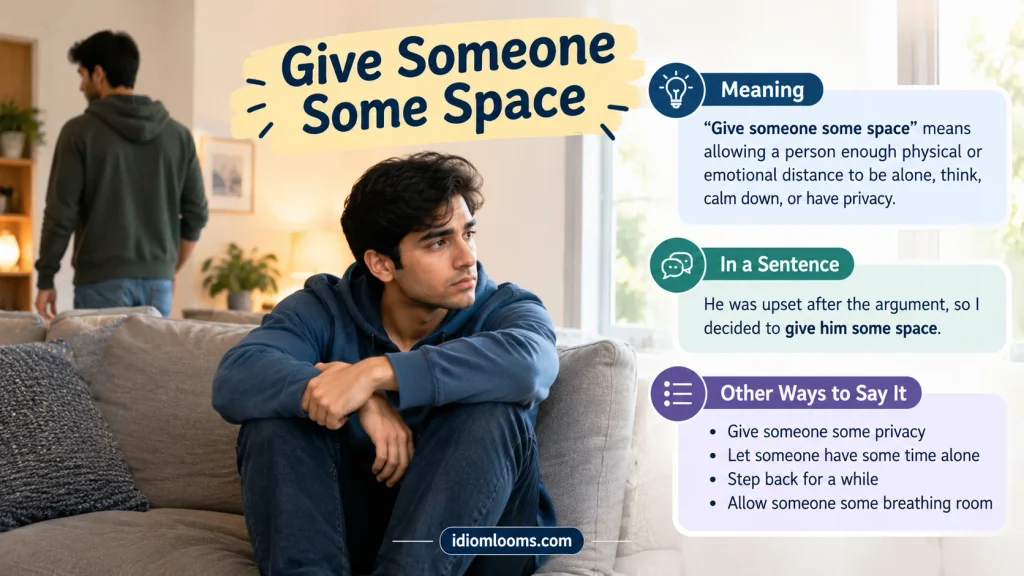
Give Someone Some Space
Meaning
“Give someone some space” means allowing a person enough physical or emotional distance to be alone, think, calm down, or have privacy.
In a Sentence
He was upset after the argument, so I decided to give him some space.
Other Ways to Say It
- Give someone some privacy
- Let someone have some time alone
- Step back for a while
- Allow someone some breathing room
Explanation
This expression treats space as something connected with personal boundaries and independence. It does not necessarily mean that someone wants to end a relationship or avoid others permanently.
The phrase is common in everyday English and can sound caring when used appropriately. Tone matters, because telling someone to “give me some space” can also sound firm when emotions are high.
Best Use
It is particularly useful in everyday conversations, relationship discussions, personal messages, and storytelling.
Make Room
Meaning
“Make room” means creating enough physical space for someone or something. It can also mean making time or allowing an opportunity for something.
In a Sentence
Move those boxes against the wall so we can make room for another chair.
Other Ways to Say It
- Create some space
- Clear some space
- Leave room for
- Make space for
Explanation
The expression presents space as something that can be created or rearranged. It is useful because it works both literally and figuratively.
You can make room for a person at a crowded table, but you can also make room in your life for a new experience. That flexibility gives the phrase several useful shades of meaning.
Best Use
Use it in conversation, instructions, essays, storytelling, and personal writing. Its figurative meaning also fits reflective writing.
Space Out
Read more:20 Idioms for Listening With Real Examples
Meaning
“Space out” can mean becoming distracted or temporarily unaware of what is happening around you. It can also mean arranging things with gaps between them.
In a Sentence
I completely spaced out during the lecture and missed the last few minutes.
Other Ways to Say It
- Zone out
- Lose concentration
- Become distracted
- Spread things apart
Explanation
When it means losing concentration, the expression creates an interesting mental image: your attention seems to drift away into its own little space.
The phrase is informal and common in everyday speech. It should not be confused with simply having a large physical area between objects.
Best Use
It works best in casual conversation, dialogue, social media, and informal storytelling. The distracted-person meaning is generally too informal for formal academic writing.
Wide Open Spaces
Meaning
“Wide open spaces” refers to large, unobstructed areas with few buildings, barriers, or people. It often suggests freedom, nature, and a sense of expansiveness.
In a Sentence
They left the crowded city behind and headed toward the wide open spaces of the countryside.
Other Ways to Say It
- Vast open land
- Expansive landscapes
- Open country
- Endless stretches of land
Explanation
Few expressions capture physical openness as directly as this one. It can make readers imagine fields, deserts, plains, mountains, or empty horizons.
The phrase often carries a positive emotional tone, suggesting independence and freedom. In some contexts, however, wide open spaces can also emphasize loneliness or isolation.
Best Use
It is especially effective in travel writing, nature descriptions, poetry, storytelling, and descriptive essays.
In the Middle of Nowhere
Meaning
“In the middle of nowhere” describes a place that is very remote or far from towns, cities, and familiar landmarks.
In a Sentence
Their cabin was in the middle of nowhere, surrounded by forests and distant mountains.
Other Ways to Say It
- In a remote area
- Far from civilization
- In the middle of the wilderness
- Miles from anywhere
Explanation
The expression creates a playful image of a location so isolated that it seems to exist in “nowhere.” It does not mean that the place literally does not exist.
Depending on the context, the phrase can sound humorous, adventurous, peaceful, or slightly negative. It is often used to emphasize remoteness rather than physical size.
Best Use
Use it in conversation, travel writing, stories, personal experiences, and informal descriptions. It is more conversational than formal.
Out of This World
Meaning
“Out of this world” means extraordinarily good, exciting, beautiful, impressive, or unusual. It can also literally evoke the idea of something beyond Earth.
In a Sentence
The view from the mountain at sunrise was out of this world.
Other Ways to Say It
- Extraordinary
- Incredible
- Remarkable
- Beyond amazing
Explanation
This expression connects excellence with the idea of leaving Earth and entering somewhere beyond ordinary experience. It is especially effective when something feels spectacular or almost unbelievable.
Although it has a connection with space imagery, it is normally used as an expression of strong praise, not as a literal description of outer space.
Best Use
It works well in conversation, reviews, social media, travel writing, creative descriptions, and enthusiastic messages. It is informal and expressive.
The Final Frontier
Meaning
“The final frontier” is a figurative expression traditionally associated with outer space as one of humanity’s great areas of exploration and discovery.
In a Sentence
For generations, the final frontier has inspired people to imagine what lies beyond Earth.
Other Ways to Say It
- The unknown frontier
- The unexplored realm
- The next great frontier
- The edge of discovery
Explanation
The phrase turns space into a symbolic boundary between the known and unknown. It suggests exploration, mystery, ambition, and discovery rather than simply describing empty distance.
It has a distinctly dramatic and poetic quality. Because of its strong association with science fiction and space exploration, it can sound more literary than everyday conversational.
Best Use
This phrase is particularly effective in speeches, science writing, documentaries, essays, science-fiction writing, and inspirational content.
No Room to Swing a Cat
Meaning
“No room to swing a cat” is an informal idiom meaning that a place is extremely small or cramped.
In a Sentence
The apartment was so tiny there was no room to swing a cat.
Other Ways to Say It
- Extremely cramped
- Very tight on space
- Barely enough room to move
- Packed into a tiny area
Explanation
The expression uses exaggerated imagery to emphasize a severe lack of space. It is not meant literally, and the unusual image is what makes it memorable.
This is an old-fashioned-sounding idiom for some speakers, but it remains understandable and useful when describing a very cramped environment. It is generally humorous or exaggerated rather than serious.
Best Use
Use it in informal conversation, humorous writing, dialogue, and storytelling. Avoid it when a neutral professional tone is required.
Packed Like Sardines
Meaning
“Packed like sardines” means that people or objects are crowded very closely together with almost no space between them.
In a Sentence
The commuters were packed like sardines on the morning train.
Other Ways to Say It
- Extremely crowded
- Shoulder to shoulder
- Cramped together
- Packed tightly
Explanation
The comparison creates a vivid image of sardines stored tightly together in a container. It communicates crowding and discomfort much more strongly than simply saying “the place was full.”
The expression is widely understood but informal. It is best used when you want to emphasize how little personal space people have.
Best Use
It fits conversation, travel stories, news-style descriptions, informal essays, and storytelling.
A Stone’s Throw Away
Meaning
“A stone’s throw away” means that something is very close by. It does not literally suggest throwing a stone at the destination.
In a Sentence
The café is just a stone’s throw away from the library.
Other Ways to Say It
- Very close
- Nearby
- Just around the corner
- Within walking distance
Explanation
The phrase uses the imagined distance a person could throw a stone to create a simple picture of short physical distance.
It is useful when exact measurements are unnecessary. The expression can also make ordinary descriptions feel more natural and conversational.
Best Use
It works well in conversation, travel writing, property descriptions, storytelling, and informal articles.
A Million Miles Away
Meaning
“A million miles away” can describe something that is extremely far away. It can also describe someone who seems mentally or emotionally distant.
In a Sentence
Although she was sitting beside us, her thoughts seemed a million miles away.
Other Ways to Say It
- Very far away
- Miles away
- Lost in thought
- Emotionally distant
Explanation
The huge number is deliberately exaggerated. It turns ordinary distance into an image of extreme separation.
This expression becomes especially powerful when used figuratively. A person can be physically present but emotionally somewhere else, making the phrase useful for reflective or emotional writing.
Best Use
Use it in conversation, poetry, personal writing, storytelling, and emotional descriptions. It is often more expressive than literal language.
Keep at Arm’s Length
Meaning
“Keep at arm’s length” means maintaining a certain distance from someone or something. It can refer to physical distance, but more commonly it means avoiding close emotional involvement.
In a Sentence
She preferred to keep unfamiliar people at arm’s length until she trusted them.
Other Ways to Say It
- Maintain some distance
- Keep your distance
- Avoid getting too close
- Maintain personal boundaries
Explanation
The expression draws on the literal length of an arm as a small protective distance. Figuratively, it represents emotional caution and boundaries.
It is useful when space is not really about geography. Instead, the “space” is between people, making this expression valuable for describing relationships and personal limits.
Best Use
It works particularly well in conversation, essays, character descriptions, relationship writing, and storytelling.
Far and Wide
Meaning
“Far and wide” means across a large area or over a broad distance. It is often used when something is searched for, spread, or known across many places.
In a Sentence
The researchers traveled far and wide to find evidence of the rare phenomenon.
Other Ways to Say It
- Across a vast area
- Everywhere
- Across the region
- Over great distances
Explanation
The pairing of “far” and “wide” creates a sense of distance in multiple directions. It suggests breadth rather than focusing on one particular route.
The expression can make descriptions feel expansive without requiring a precise measurement. It is also natural enough for both everyday and more polished writing.
Best Use
It suits storytelling, essays, travel writing, speeches, journalism, and descriptive prose.
Off the Beaten Track
Meaning
“Off the beaten track” describes a place or activity that is away from the usual, crowded, or well-known routes.
In a Sentence
We found a quiet observatory off the beaten track, far from the tourist crowds.
Other Ways to Say It
- Away from the usual route
- In a less-visited area
- Away from the crowds
- Hidden away
Explanation
The phrase creates an image of leaving a well-used path and entering a less familiar space. It suggests discovery, independence, and sometimes adventure.
It does not necessarily mean a place is extremely remote. Instead, the emphasis is on being outside the usual path or mainstream experience.
Best Use
It is especially effective in travel writing, adventure stories, blogs, recommendations, and descriptive essays.
On the Map
Meaning
“On the map” means that a place has become known, recognized, or important. It can be literal, but it is often used figuratively.
In a Sentence
The new observatory put the small mountain town on the map.
Other Ways to Say It
- Make something well known
- Bring attention to a place
- Put a place in the spotlight
- Gain recognition
Explanation
A location literally appears on a map, but figuratively being “on the map” means becoming noticeable or significant.
This expression shows that space is not only about physical distance. A location can also gain a stronger presence in people’s awareness.
Best Use
It works well in journalism, business writing, travel content, speeches, storytelling, and everyday conversation.
As Far as the Eye Can See
Meaning
“As far as the eye can see” describes something extending across a very large visible area, often toward a distant horizon.
In a Sentence
Snow-covered fields stretched as far as the eye could see.
Other Ways to Say It
- As far as the horizon
- Across the entire landscape
- For miles in every direction
- Stretching into the distance
Explanation
This expression makes the reader imagine standing in a place where the landscape extends beyond what the eyes can comfortably take in. It creates a strong sense of vastness and scale.
It is especially effective for landscapes, oceans, deserts, fields, skies, and other visually expansive settings.
Best Use
Use it in creative writing, travel descriptions, poetry, nature writing, and storytelling. It has a distinctly descriptive and somewhat poetic quality.
Go the Distance
Meaning
“Go the distance” means continuing until a goal is reached, especially when something requires determination, endurance, or commitment.
In a Sentence
The mission will be challenging, but the team is ready to go the distance.
Other Ways to Say It
- See it through
- Keep going
- Stay the course
- Reach the goal
Explanation
The expression treats a goal as a distance that must be traveled. The physical idea of covering ground becomes a metaphor for persistence.
This makes it particularly useful when space represents a journey rather than a location. It can describe physical travel, personal ambitions, relationships, or difficult projects.
Best Use
It works naturally in speeches, motivational writing, sports discussions, conversations, and inspirational messages.
A World Away
Meaning
“A world away” means very far from a particular place, situation, experience, or state of mind. It can describe physical or emotional distance.
In a Sentence
The quiet island felt a world away from the noise of the capital.
Other Ways to Say It
- Far removed
- Completely different
- Very distant
- A long way from here
Explanation
Instead of giving an exact distance, the expression imagines an entire world between two experiences. This makes it useful for both physical geography and emotional contrast.
It often sounds reflective or slightly poetic, especially when comparing a peaceful place with a stressful environment.
Best Use
It is excellent for travel writing, personal essays, creative writing, storytelling, and reflective descriptions.
The Sky’s the Limit
Meaning
“The sky’s the limit” means there is no obvious limit to what someone can achieve or how far something can develop.
In a Sentence
With the right support and imagination, the sky’s the limit for what this project could become.
Other Ways to Say It
- Anything is possible
- There is no limit to what you can achieve
- The possibilities are endless
- You can go as far as you want
Explanation
The sky represents an enormous upper boundary, so the expression turns open space into a symbol of possibility and ambition.
Although it is not specifically an astronomy expression, its imagery connects naturally with ideas of height, exploration, and limitless potential. It has an optimistic and motivational tone.
Best Use
This phrase works especially well in speeches, motivational messages, educational writing, business communication, and personal encouragement.
Exercise: Practice Using Idioms
Choose the best answer for each question.
Which expression means having enough space to feel comfortable?
A. On the map
B. Room to breathe
C. Far and wide
D. Go the distance
What does “give someone some space” usually mean?
A. Give them more furniture
B. Move them to another building
C. Allow them privacy or time alone
D. Make their room larger
Which expression describes an extremely small or cramped place?
A. No room to swing a cat
B. A world away
C. Wide open spaces
D. Far and wide
What does “packed like sardines” suggest?
A. Moving at a slow pace
B. Standing very close together
C. Traveling across long distances
D. Sitting outside in the open air
Which expression means “very close”?
A. A million miles away
B. In the middle of nowhere
C. A stone’s throw away
D. Off the beaten track
What can “a million miles away” describe besides physical distance?
A. Being emotionally or mentally distant
B. Having excellent organizational skills
C. Staying physically nearby
D. Moving at a very fast pace
Which expression is most closely connected with maintaining emotional boundaries?
A. On the map
B. Keep at arm’s length
C. Far and wide
D. Make room
What does “off the beaten track” suggest about a location?
A. Extremely crowded with people
B. Located right beside a highway
C. Situated away from the usual route
D. Almost impossible to find
Which expression can mean that a place has become recognized or well known?
A. On the map
B. Space out
C. A stone’s throw away
D. Room to breathe
What does “as far as the eye can see” emphasize?
A. Exact measurements
B. Visual vastness
C. Emotional conflict
D. Personal boundaries
Which expression is especially useful for describing a vast natural landscape?
A. Wide open spaces
B. Keep at arm’s length
C. Make room
D. Space out
What does “go the distance” usually communicate figuratively?
A. Giving up early
B. Moving to another country
C. Continuing until a goal is reached
D. Avoiding a difficult task
Which expression is strongly associated with outer-space exploration?
A. The final frontier
B. No room to swing a cat
C. A stone’s throw away
D. Packed like sardines
Which expression can describe a place that feels very different from another place?
A. Make room
B. A world away
C. Far and wide
D. Space out
What does “the sky’s the limit” communicate?
A. There are very few possibilities
B. A location is difficult to reach
C. Something is physically above the clouds
D. There is great potential for achievement
Answers
- B — “Room to breathe” means having enough physical or figurative space to feel comfortable.
- C — “Give someone some space” means allowing them privacy, distance, or time alone.
- A — “No room to swing a cat” humorously describes a place that is extremely cramped.
- B — “Packed like sardines” means people or objects are crowded very closely together.
- C — “A stone’s throw away” describes something that is very close.
- A — “A million miles away” can describe someone who is mentally distracted or emotionally distant.
- B — “Keep at arm’s length” means maintaining physical or emotional distance.
- C — “Off the beaten track” refers to a location away from common or well-traveled routes.
- A — Being “on the map” figuratively means becoming recognized or well known.
- B — “As far as the eye can see” emphasizes the enormous visible extent of a landscape or scene.
- A — “Wide open spaces” is especially suitable for large, unobstructed landscapes.
- C — “Go the distance” means continuing with determination until a goal is achieved.
- A — “The final frontier” is a well-known figurative expression for space as a realm of exploration.
- B — “A world away” emphasizes a large physical, emotional, or experiential difference.
- D — “The sky’s the limit” means there is great or seemingly unlimited potential.
FAQs
What is an idiom for space?
An idiom or figurative expression for space uses familiar imagery to communicate ideas about distance, openness, crowding, privacy, freedom, or vastness. Examples include “room to breathe,” “wide open spaces,” and “a stone’s throw away.”
How do I create my own idiom for space?
Start with the idea you want to communicate, such as freedom or distance. Then connect it with a clear mental image. For example, if you want to express unlimited possibilities, you might compare opportunity with an endless horizon.
What makes an idiom effective?
An effective idiom creates a recognizable image while communicating a specific idea. The strongest expressions are clear, memorable, and appropriate for the context rather than simply being decorative.
Can I use these idioms in everyday conversation?
Yes. Expressions such as “make room,” “give someone some space,” “a stone’s throw away,” and “packed like sardines” are natural in everyday English. More dramatic phrases, such as “the final frontier,” may fit better in creative or formal contexts.
What is the difference between an idiom and a simile?
An idiom is a conventional expression with a recognized figurative meaning, while a simile directly compares two things using words such as “like” or “as.” For example, “packed like sardines” contains a simile, while “give someone some space” is an idiomatic expression.
Conclusion
Space can represent much more than physical area. It can suggest freedom, privacy, distance, isolation, possibility, discovery, or wonder. The expressions in this guide show how English uses familiar images to communicate those ideas in memorable ways.
When choosing an idiom for space, think first about the feeling or message you want to create. “Wide open spaces” can suggest freedom, while “packed like sardines” emphasizes crowding. “A world away” can express emotional or physical distance, while “the sky’s the limit” turns open space into a symbol of possibility.
The best figurative expression is not necessarily the most dramatic one. It is the one that fits your context and communicates your intended meaning clearly. With the right imagery, even an empty horizon can become a powerful way to express an idea.

Eleanor Prose is a writer and English teacher with a soft spot for the phrases that trip us up. She has spent years helping students and professionals use idioms with confidence not just memorizing them, but understanding the culture and humor behind each one.
Through Idiom Looms, Eleanor explores the threads that connect language, history, and everyday conversation. Her goal is simple: to make English idioms clear, memorable, and actually fun to use.
She writes from a quiet desk surrounded by notebooks, and firmly believes there’s an idiom for every situation usually more than one.