

Have you ever noticed how a simple phrase can make a conversation more lively? The 20 Idioms for Teens With Real Examples in this guide introduce natural expressions teens can use in everyday English. These phrases can make conversations, stories, messages, and creative writing more expressive and memorable. Learning idioms also helps teens understand figurative language, context, and everyday English usage without making communication sound forced or complicated.
From casual conversations to school assignments, idioms can add personality and clarity. You will discover expressions connected with feelings, friendship, success, challenges, fun, communication, and everyday situations. The examples show how each idiom works naturally in context. Along the way, you can strengthen grammar, improve vocabulary, and develop greater consistency in your English usage. These skills can also support formal writing, presentations, speeches, and classroom discussions.
This guide also connects language learning with practical communication skills. Whether you are discussing scheduling, time management, meetings, or a calendar, natural expressions can make your English more engaging. Even topics such as business communication, online booking, broadcasting, and project management use clear, contextual language. Each idiom includes its meaning, a real example, alternative expressions, and guidance on where it fits best. By the end, you will have practical phrases that make everyday English more confident, vivid, and natural.
What Is an Idiom?
An idiom is a fixed expression that has a figurative meaning rather than a completely literal one.
For example, if someone says, “Break a leg,” they are not actually asking you to injure yourself. The phrase means “Good luck,” especially before a performance.
Another example is “hit the books.” It does not mean physically hitting books. It means to study seriously.
Idioms differ from literal statements because their intended meaning goes beyond the individual words. They add imagery, personality, and emotion to everyday communication.
Why Use Idioms for Teens?
Teen experiences are full of situations that can be difficult to explain with simple literal language. Idioms give those experiences a stronger voice.
They can help teens:
- Express emotions without using long explanations.
- Make descriptions more colorful and memorable.
- Explain challenging or abstract experiences.
- Add personality to conversations and stories.
- Make creative writing more engaging.
- Communicate complicated feelings in a familiar way.
- Make speeches, essays, and personal writing sound more natural.
For example, saying a teenager is “finding their feet” suggests more than simply saying they are adjusting. It creates an image of someone learning how to stand confidently in a new situation.
Quick List of 20 Idioms
- Find your feet
- Hit the books
- Go the extra mile
- Break out of your shell
- Keep your chin up
- Weather the storm
- Learn the ropes
- Bite the bullet
- On the same wavelength
- A breath of fresh air
- Go with the flow
- Step up to the plate
- Have a change of heart
- In hot water
- Jump on the bandwagon
- The ball is in your court
- Open a can of worms
- See eye to eye
- Once in a blue moon
- A mixed bag
Find Your Feet
Read more:20 Idioms for Starting With Real Examples
Meaning
Find your feet means to become comfortable, confident, or independent in a new situation.
For a teen, this might describe starting a new school, joining a club, making new friends, or becoming comfortable with greater responsibility.
In a Sentence
After a few nervous weeks at her new school, Maya finally found her feet and started enjoying her classes.
Other Ways to Say It
- Get comfortable
- Adjust to a new situation
- Find your confidence
- Settle in
Explanation
The phrase creates an image of someone learning how to stand steadily after entering unfamiliar surroundings. It works especially well when someone needs time to adjust before feeling confident.
Best Use
Use this idiom in personal writing, conversations, storytelling, and essays about change or growing independence. It has a supportive and encouraging tone.
Hit the Books
Meaning
Hit the books means to study or begin studying seriously.
It is especially useful when talking about exams, homework, assignments, or preparing for an important test.
In a Sentence
I can’t hang out tonight because I need to hit the books before tomorrow’s science exam.
Other Ways to Say It
- Study hard
- Get down to studying
- Review your work
- Prepare for an exam
Explanation
The phrase creates a playful picture of someone immediately turning their attention toward their books. It is informal and energetic, rather than serious or academic in tone.
Best Use
This idiom works best in casual conversations, messages, school-related writing, and social posts. It may sound too informal for a formal academic essay.
Go the Extra Mile
Meaning
Go the extra mile means to make more effort than is normally expected.
A teen might use it when describing someone who works especially hard on a school project, helps a friend, or practices for an important goal.
In a Sentence
Our team captain went the extra mile by helping everyone prepare for the presentation.
Other Ways to Say It
- Make an extra effort
- Give more than expected
- Put in additional work
- Do your best
Explanation
The image comes from traveling farther than necessary. It suggests extra effort and commitment, not simply completing the basic task.
Best Use
It fits speeches, essays, school projects, conversations, and motivational writing. Its tone is usually positive and encouraging.
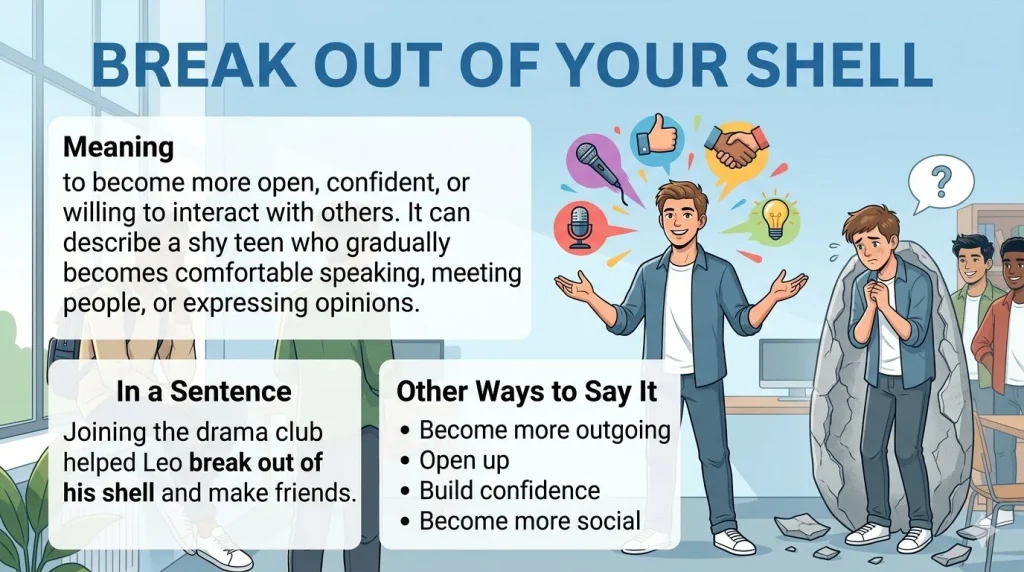
Break Out of Your Shell
Meaning
Break out of your shell means to become more open, confident, or willing to interact with others.
It can describe a shy teen who gradually becomes comfortable speaking, meeting people, or expressing opinions.
In a Sentence
Joining the drama club helped Leo break out of his shell and make friends.
Other Ways to Say It
- Become more outgoing
- Open up
- Build confidence
- Become more social
Explanation
The phrase compares shyness to being inside a protective shell. Breaking out suggests gaining freedom and confidence rather than changing who you are completely.
Best Use
This expression works naturally in personal stories, conversations, school essays, and encouraging messages. It can sound warm and positive.
Keep Your Chin Up
Meaning
Keep your chin up means to remain hopeful and positive during a difficult situation.
It is often used to encourage someone who is disappointed, worried, or facing a setback.
In a Sentence
You didn’t get the part this time, but keep your chin up—there will be another audition.
Other Ways to Say It
- Stay positive
- Don’t lose hope
- Stay strong
- Keep going
Explanation
The phrase creates an image of someone physically lifting their head instead of looking down in defeat. It communicates encouragement, resilience, and hope.
Best Use
Use it in supportive conversations, personal messages, speeches, and motivational writing. It is friendly rather than formal.
Weather the Storm
Meaning
Weather the storm means to survive or endure a difficult period until conditions improve.
For teens, it can describe getting through exam pressure, friendship problems, family difficulties, or other stressful periods.
In a Sentence
The first semester was difficult, but we weathered the storm and finished the year strongly.
Other Ways to Say It
- Get through a difficult time
- Endure the challenge
- Stay strong through hardship
- Make it through
Explanation
The idiom compares a difficult period to a powerful storm that eventually passes. It emphasizes patience and resilience rather than pretending that the problem is easy.
Best Use
It is particularly effective in essays, speeches, storytelling, and serious conversations about challenges.
Learn the Ropes
Meaning
Learn the ropes means to learn how something works or understand what you need to do in a new situation.
A teen might use it when starting a new job, joining a team, or taking on a new responsibility.
In a Sentence
It took me a couple of weeks to learn the ropes at my weekend job.
Other Ways to Say It
- Learn how things work
- Get the hang of it
- Learn the basics
- Become familiar with a task
Explanation
The expression comes from an older association with learning how to handle ropes on a ship. Today, it means gaining practical knowledge through experience.
Best Use
It works well in conversations, workplace situations, personal writing, and storytelling. It is informal but widely understandable.
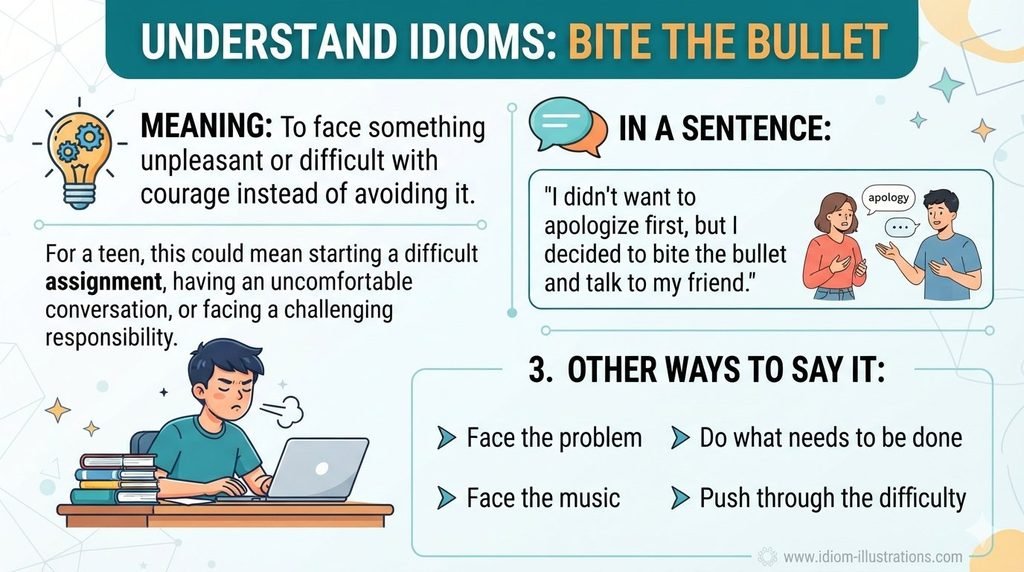
Bite the Bullet
Meaning
Bite the bullet means to face something unpleasant or difficult with courage instead of avoiding it.
For a teen, this could mean finally starting a difficult assignment, having an uncomfortable conversation, or facing a challenging responsibility.
In a Sentence
I didn’t want to apologize first, but I decided to bite the bullet and talk to my friend.
Other Ways to Say It
- Face the problem
- Do what needs to be done
- Face the music
- Push through the difficulty
Explanation
The phrase creates a dramatic image of someone enduring pain by biting down on a bullet. Today, it suggests courage in an uncomfortable situation.
Best Use
Use it in casual conversations, storytelling, and personal writing. Because the imagery is dramatic, it may sound too informal for some professional contexts.
On the Same Wavelength
Meaning
On the same wavelength means two or more people understand each other well or think similarly about something.
It is especially useful for describing close friendships and teamwork.
In a Sentence
Jamal and I are on the same wavelength, so group projects usually go smoothly.
Other Ways to Say It
- Think alike
- Understand each other
- See things similarly
- Be in agreement
Explanation
The phrase compares people to radio signals operating at the same frequency. When they are on the same wavelength, their ideas and understanding connect naturally.
Best Use
It works particularly well in conversations, friendship stories, teamwork discussions, and informal writing.
A Breath of Fresh Air
Meaning
A breath of fresh air describes someone or something that feels pleasantly new, refreshing, or different.
A new friend, teacher, activity, or idea can all be described this way.
In a Sentence
Our new art teacher was a breath of fresh air after years of following the same routine.
Other Ways to Say It
- Refreshing
- A welcome change
- Something different
- A positive change
Explanation
The expression compares a refreshing experience to breathing clean, fresh air. It communicates relief, excitement, and renewed energy.
Best Use
This idiom fits reviews, conversations, essays, social posts, and creative writing. It usually has a warm and positive tone.

Go with the Flow
Meaning
Go with the flow means to accept a situation and adapt instead of trying to control every detail.
It can describe a teen who stays flexible when plans suddenly change.
In a Sentence
We didn’t know where the afternoon would take us, so we decided to go with the flow.
Other Ways to Say It
- Stay flexible
- Take things as they come
- Adapt to the situation
- Relax and see what happens
Explanation
The phrase creates an image of floating along with moving water instead of constantly fighting the current. It suggests flexibility and a relaxed attitude.
Best Use
It is most natural in casual conversation, travel stories, personal messages, and lifestyle writing.
Step Up to the Plate
Meaning
Step up to the plate means to accept a responsibility or challenge and make an effort to handle it.
It is useful when describing leadership, teamwork, or moments when someone needs to take action.
In a Sentence
When our class needed someone to lead the fundraiser, Priya stepped up to the plate.
Other Ways to Say It
- Take responsibility
- Rise to the challenge
- Take action
- Accept the task
Explanation
The idiom comes from baseball, where a batter steps up to the plate to face the pitcher. The image communicates readiness, courage, and responsibility.
Best Use
It works especially well in speeches, school essays, leadership discussions, and motivational writing.
Have a Change of Heart
Meaning
Have a change of heart means to change your opinion, decision, or feelings about something.
The change is often connected to emotions rather than new facts alone.
In a Sentence
I planned to quit the club, but after talking to my teammates, I had a change of heart.
Other Ways to Say It
- Change your mind
- Rethink your decision
- Feel differently
- Decide differently
Explanation
The heart is traditionally associated with feelings, so the expression presents a change in attitude as an emotional shift. It can suggest compassion, reconsideration, or personal growth.
Best Use
This idiom is useful in personal stories, conversations, fiction, and reflective essays.
In Hot Water
Meaning
In hot water means to be in trouble or facing consequences because of something you have done.
In a Sentence
I was in hot water after forgetting to submit the group assignment on time.
Other Ways to Say It
- In trouble
- Facing consequences
- In a difficult situation
- In a tight spot
Explanation
The phrase creates an uncomfortable image of literally being surrounded by hot water. Figuratively, it describes pressure, trouble, or an awkward situation.
Best Use
It works well in casual conversations, humorous stories, and everyday writing. Its tone can be serious or playful depending on the situation.
Jump on the Bandwagon
Meaning
Jump on the bandwagon means to join something because it has become popular or many other people are doing it.
It can describe trends, hobbies, challenges, fashion, entertainment, or social activities.
In a Sentence
Everyone started playing the new game, and eventually I jumped on the bandwagon too.
Other Ways to Say It
- Join the trend
- Follow the crowd
- Get involved
- Join something popular
Explanation
The phrase comes from the image of people climbing onto a bandwagon associated with a popular movement or event. It can suggest enthusiasm, but sometimes it hints that someone is following others without thinking independently.
Best Use
This idiom fits casual conversations, social media discussions, essays, and commentary about trends.
The Ball Is in Your Court
Meaning
The ball is in your court means it is now your responsibility to decide what happens next or take the next action.
In a Sentence
I’ve explained why I’m upset, so the ball is in your court now.
Other Ways to Say It
- It’s your decision
- It’s your turn to act
- The next move is yours
- It’s up to you
Explanation
The expression uses a tennis court as its mental image. If the ball is on your side, you must make the next move.
Best Use
It works well in conversations, messages, storytelling, and persuasive writing. Depending on tone, it can sound calm, confident, or slightly challenging.
Open a Can of Worms
Meaning
Open a can of worms means to create a complicated problem or introduce many difficult questions by dealing with one issue.
In a Sentence
Asking everyone about the old argument might open a can of worms that the group isn’t ready to discuss.
Other Ways to Say It
- Create more problems
- Raise complicated issues
- Make things more complicated
- Start a difficult discussion
Explanation
The image is intentionally messy: opening a container full of worms would create a problem that is difficult to control. Figuratively, it represents unexpected complications.
Best Use
This idiom is effective in conversations, opinion writing, storytelling, and discussions about sensitive or complicated topics.
See Eye to Eye
Meaning
See eye to eye means to agree with someone or share the same opinion.
In a Sentence
My brother and I don’t always see eye to eye, but we still respect each other’s opinions.
Other Ways to Say It
- Agree
- Share the same view
- Be in agreement
- Think alike
Explanation
The expression creates an image of two people looking directly at each other at the same level. It suggests agreement and shared understanding, not necessarily friendship.
Best Use
Use it in conversations, essays, debates, and personal writing when discussing agreement or disagreement.
Once in a Blue Moon
Meaning
Once in a blue moon means something happens very rarely.
It is useful for describing unusual events or activities that do not happen often.
In a Sentence
We only get to visit our cousins once in a blue moon, so we try to make every visit count.
Other Ways to Say It
- Very rarely
- Hardly ever
- Almost never
- On rare occasions
Explanation
The phrase gives rarity a memorable image by connecting an unusual event with a “blue moon.” It sounds more colorful and conversational than simply saying “rarely.”
Best Use
It works naturally in everyday conversations, stories, social posts, and creative writing.
A Mixed Bag
Meaning
A mixed bag describes something containing a combination of good and bad, positive and negative, or different types of experiences.
In a Sentence
My first month at the new school was a mixed bag—I loved some classes but struggled with others.
Other Ways to Say It
- A combination of positives and negatives
- A mixture of experiences
- Some good and some bad
- A varied experience
Explanation
The phrase creates the image of opening a bag and discovering a variety of things inside. For teens, it can describe complicated experiences that cannot be labeled simply as good or bad.
Best Use
It is especially useful in reviews, personal essays, conversations, and reflective writing because it allows room for nuance.
Exercise: Practice Using Idioms
Test your understanding of the expressions above. Choose the best answer for each question.
1. What does “find your feet” mean?
A. Learn to dance
B. Become comfortable in a new situation
C. Walk somewhere quickly
D. Avoid responsibility
2. Which idiom means to study seriously?
A. Go with the flow
B. Hit the books
C. See eye to eye
D. Open a can of worms
3. Someone who “goes the extra mile” usually:
A. Travels frequently
B. Avoids difficult work
C. Makes additional effort
D. Changes their plans
4. What does “break out of your shell” suggest?
A. Becoming more confident and open
B. Leaving school early
C. Ending a friendship
D. Avoiding social situations
5. Which sentence uses “keep your chin up” correctly?
A. Keep your chin up while tying your shoes.
B. Keep your chin up because the disappointing result isn’t the end.
C. Keep your chin up to find your lost pencil.
D. Keep your chin up when opening your backpack.
6. If someone “weathers the storm,” what are they doing?
A. Predicting the weather
B. Avoiding all responsibility
C. Getting through a difficult period
D. Planning a vacation
7. What does “learn the ropes” mean?
A. Learn how something works
B. Learn how to swim
C. Memorize a poem
D. Repair a rope
8. Two friends who are “on the same wavelength” usually:
A. Live in the same house
B. Have identical schedules
C. Understand or think similarly
D. Enjoy the same sport only
9. Which situation best fits “a breath of fresh air”?
A. A disappointing exam result
B. A refreshing new idea after a dull routine
C. A difficult argument
D. A forgotten homework assignment
10. What does “go with the flow” encourage someone to do?
A. Stay flexible and adapt
B. Control every detail
C. Ignore everyone
D. Work without resting
11. A student who “steps up to the plate” is likely to:
A. Leave the activity
B. Accept a challenge or responsibility
C. Refuse to participate
D. Change schools
12. If someone “has a change of heart,” they:
A. Become physically stronger
B. Change their opinion or feelings
C. Forget someone’s name
D. Start a new hobby
13. What does “in hot water” mean?
A. Feeling physically warm
B. Preparing a bath
C. Being in trouble
D. Going swimming
14. If a teen “jumps on the bandwagon,” they:
A. Follow a popular trend or activity
B. Leave a group
C. Reject a popular idea
D. Start a private project
15. If “the ball is in your court,” what does that mean?
A. Missing the opportunity
B. Needing to leave immediately
C. Making the next decision or taking action
D. Having someone else decide for you
Answers
- B — “Find your feet” means becoming comfortable and confident in a new situation.
- B — “Hit the books” is an informal way to say study seriously.
- C — Going the extra mile means making more effort than expected.
- A — Breaking out of your shell means becoming more open, confident, or socially comfortable.
- B — “Keep your chin up” is used to encourage someone who is facing disappointment or difficulty.
- C — Weathering the storm means successfully enduring a difficult period.
- A — Learning the ropes means learning how something works, especially in a new environment.
- C — People on the same wavelength understand each other or have similar ideas.
- B — A breath of fresh air describes something pleasantly new or refreshing.
- A — Going with the flow means staying flexible and accepting changing circumstances.
- B — Stepping up to the plate means accepting a challenge or responsibility.
- B — Having a change of heart means changing your feelings, opinion, or decision.
- C — Being in hot water means being in trouble or facing consequences.
- A — Jumping on the bandwagon means joining something because it has become popular.
- C — When the ball is in your court, the next action or decision is your responsibility.
FAQs
What is an idiom for teens?
An idiom for teens is a figurative expression that can naturally describe experiences such as friendships, school, challenges, confidence, responsibility, and growing independence. Examples include “hit the books,” “find your feet,” and “go with the flow.”
How do I create my own idiom?
Start with a clear idea or feeling, then connect it to a strong mental image. For example, if you want to describe someone becoming confident, you could imagine a person stepping onto a stage. The image should make the intended meaning easier to understand.
What makes an idiom effective?
A good idiom creates a memorable comparison while communicating a clear idea. Strong figurative language is usually specific, easy to understand, and appropriate for the situation.
Can I use these idioms in everyday conversation?
Yes. Many of these expressions, such as “hit the books,” “keep your chin up,” and “go with the flow,” are natural in informal conversation. However, some idioms may sound too casual or figurative for formal academic writing, so consider your audience.
What is the difference between an idiom and a simile?
An idiom has a recognized figurative meaning, such as “hit the books” meaning to study. A simile directly compares two things using words such as “like” or “as,” as in “He runs like the wind.” Both can create imagery, but they work differently.
Conclusion
Idioms give ordinary ideas a more vivid and memorable voice. For teens, they can describe everything from studying and friendship to confidence, responsibility, setbacks, and changing feelings. Expressions such as “find your feet” can capture the experience of adjusting, while “weather the storm” communicates resilience during difficult moments. The key is not to use an idiom simply because it sounds interesting. Choose one that genuinely matches the feeling, situation, and audience.
In conversation, creative writing, school assignments, or personal messages, a well-chosen expression can make a simple idea much more engaging. The strongest idiom is the one that helps your reader or listener immediately picture and understand the experience behind your words.

Eleanor Prose is a writer and English teacher with a soft spot for the phrases that trip us up. She has spent years helping students and professionals use idioms with confidence not just memorizing them, but understanding the culture and humor behind each one.
Through Idiom Looms, Eleanor explores the threads that connect language, history, and everyday conversation. Her goal is simple: to make English idioms clear, memorable, and actually fun to use.
She writes from a quiet desk surrounded by notebooks, and firmly believes there’s an idiom for every situation usually more than one.



[…] Read more:20 Idioms for Teens With Real Examples […]