
What happens when you want to express a thoughtful idea but ordinary words feel too plain? The 20 Idioms for Thinking With Real Examples will help you explore natural expressions for describing thoughts, ideas, reflection, and mental processes. Idioms can make everyday English more vivid while adding personality to conversations and writing. They also help learners understand figurative language, English usage, and grammar in authentic contexts.
Thinking plays a role in many areas of communication. It can influence business communication, meetings, project management, and even formal writing. Clear thinking also supports better time management, scheduling, and planning around a calendar. Although terms such as online booking and broadcasting may seem unrelated, strong communication skills help people explain decisions, plans, and ideas consistently across different settings.
In this article, you will discover 20 useful idioms connected with thinking and reasoning, each explained through a clear meaning and real example. You will also learn alternative expressions, practical usage, and situations where each idiom sounds natural. The examples can strengthen your creative expression, improve communication, and build greater consistency in English. By the end, you will have practical expressions for describing opinions, ideas, decisions, doubts, and deeper thought with confidence.
What Is an Idiom?
An idiom is a fixed expression with a figurative meaning that cannot always be understood by taking every word literally.
For example, “break the ice” does not mean physically breaking ice. It means to make people feel more comfortable when they first meet.
Likewise, “see eye to eye” does not literally mean looking into someone’s eyes. It means to agree with someone.
Idioms add imagery and personality to language. Rather than stating an idea in a plain way, they allow speakers and writers to communicate it through a familiar comparison or mental picture.
Why Use Idioms for Thinking?
Thinking can be difficult to describe because it happens inside the mind. Idioms make these invisible processes easier to express.
They can show whether someone is:
- Thinking deeply about a problem.
- Struggling to find an answer.
- Considering different possibilities.
- Suddenly having an idea.
- Changing their opinion.
- Refusing to accept an obvious conclusion.
- Looking at a problem from another perspective.
For example, “put your thinking cap on” makes mental effort sound playful and visual, while “food for thought” suggests an idea worth considering carefully.
These expressions are especially useful in creative writing, conversations, speeches, essays, and storytelling because they can make an abstract thought easier to picture and remember.
Quick List of 20 Idioms
- Put Your Thinking Cap On
- Food for Thought
- Think Outside the Box
- Put Two and Two Together
- Give It Some Thought
- Ponder Over It
- Rack Your Brain
- Pick Someone’s Brain
- Have Something on Your Mind
- Read Between the Lines
- See the Bigger Picture
- A Light-Bulb Moment
- Get Your Head Around Something
- Wrap Your Head Around Something
- Think on Your Feet
- Lose Your Train of Thought
- Go Over Something in Your Head
- Change Your Mind
- A Lot on Your Plate
- Second-Guess Yourself
Put Your Thinking Cap On
Read more:20 Idioms for Teens With Real Examples
Meaning
“Put your thinking cap on” means to prepare yourself to think carefully or solve a problem. The expression creates a playful image of putting on a special cap that helps your brain work.
In a Sentence
We have a tricky puzzle to solve, so put your thinking cap on and see what you can come up with.
Other Ways to Say It
- Think carefully.
- Get ready to solve the problem.
- Put your mind to work.
- Concentrate on the challenge.
Explanation
The idiom treats thinking as if it were a skill you can switch on by putting on special equipment. Its playful imagery makes serious mental effort sound lighter and more approachable.
It works particularly well when encouraging someone to solve a puzzle, answer a difficult question, or come up with an idea.
Best Use
This expression is best for friendly conversations, classrooms, puzzles, storytelling, and informal writing. It can sound too playful for highly formal or technical writing.
Food for Thought
Meaning
“Food for thought” describes an idea or piece of information that gives someone something interesting or important to consider.
In a Sentence
Her comments about the future of education gave me food for thought during my commute home.
Other Ways to Say It
- Something worth considering.
- An idea to think about.
- Something to reflect on.
- A thought-provoking point.
Explanation
The expression compares an idea to food that feeds the mind. Just as food satisfies physical hunger, an interesting idea can satisfy intellectual curiosity or encourage deeper reflection.
It is especially effective when an observation does not require an immediate answer but deserves further consideration.
Best Use
Use it in conversations, essays, speeches, articles, and reflective writing. It has a thoughtful tone without sounding overly dramatic.
Think Outside the Box
Meaning
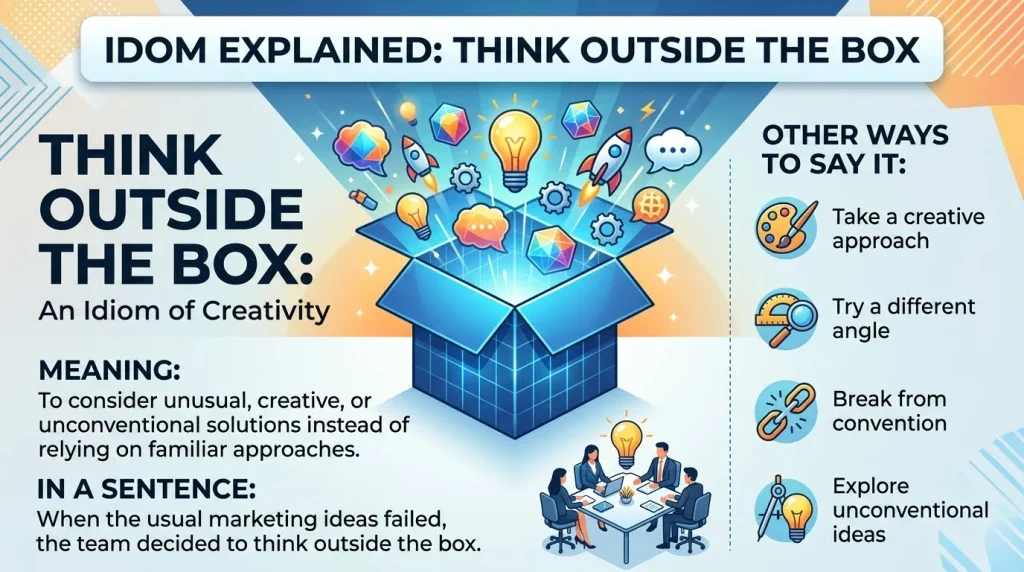
“Think outside the box” means to consider unusual, creative, or unconventional solutions instead of relying on familiar approaches.
In a Sentence
When the usual marketing ideas failed, the team decided to think outside the box.
Other Ways to Say It
- Take a creative approach.
- Try a different angle.
- Break from convention.
- Explore unconventional ideas.
Explanation
The “box” represents familiar limits or conventional thinking. Stepping outside it suggests freedom from ordinary assumptions.
This idiom is useful when someone needs to solve a problem creatively rather than simply repeating what has worked before.
Best Use
It fits naturally in workplace conversations, brainstorming sessions, education, problem-solving, and motivational writing.
Put Two and Two Together
Meaning
“Put two and two together” means to connect separate pieces of information and reach a logical conclusion.
In a Sentence
When I noticed that both the lights and the internet had stopped working, I put two and two together and realized there was a power outage.
Other Ways to Say It
- Connect the clues.
- Figure it out.
- Draw a conclusion.
- Make the connection.
Explanation
The expression uses simple arithmetic as an image for logical reasoning. The two pieces of information are like separate numbers that become meaningful when combined.
It works especially well when the conclusion seems obvious after the clues have been connected.
Best Use
Use it in everyday conversation, storytelling, mysteries, explanations, and informal writing. It is generally too casual for highly formal academic prose.
Give It Some Thought
Meaning
“Give it some thought” means to spend time considering something carefully before making a decision or giving an answer.
In a Sentence
I’m not ready to accept the offer yet, but I’ll give it some thought tonight.
Other Ways to Say It
- Think it over.
- Consider it carefully.
- Reflect on it.
- Take some time to decide.
Explanation
This idiom emphasizes deliberation rather than immediate reaction. It suggests that an idea deserves mental attention before a person reaches a conclusion.
It is useful when you want to show that you are taking a suggestion or decision seriously.
Best Use
It works well in conversations, personal messages, workplace communication, and everyday decision-making. It has a calm and neutral tone.
Ponder Over It
Meaning
“Ponder over it” means to think deeply and carefully about something, usually for a period of time.
In a Sentence
He sat quietly by the window, pondering over the decision he had to make.
Other Ways to Say It
- Think deeply about it.
- Reflect on it.
- Contemplate it.
- Consider it carefully.
Explanation
The word “ponder” suggests slow, thoughtful consideration rather than a quick mental response. It often gives a more reflective feeling than simply saying “think.”
The expression can create an image of someone quietly examining a question from several angles.
Best Use
It is particularly suitable for creative writing, reflective essays, storytelling, and thoughtful conversations. It can sound somewhat literary in casual speech.
Rack Your Brain
Meaning
“Rack your brain” means to think extremely hard to remember something, solve a problem, or find an answer.
In a Sentence
I’ve been racking my brain trying to remember where I left my keys.
Other Ways to Say It
- Think very hard.
- Search your memory.
- Struggle to remember.
- Work hard to find an answer.
Explanation
The phrase creates a dramatic image of putting intense pressure on the brain. It communicates mental effort and frustration, especially when the answer does not come easily.
It is more expressive than simply saying, “I am trying to remember.”
Best Use
Use it in informal conversations, humorous writing, storytelling, and everyday situations. Its dramatic wording makes it less suitable for formal academic writing.
Pick Someone’s Brain
Meaning
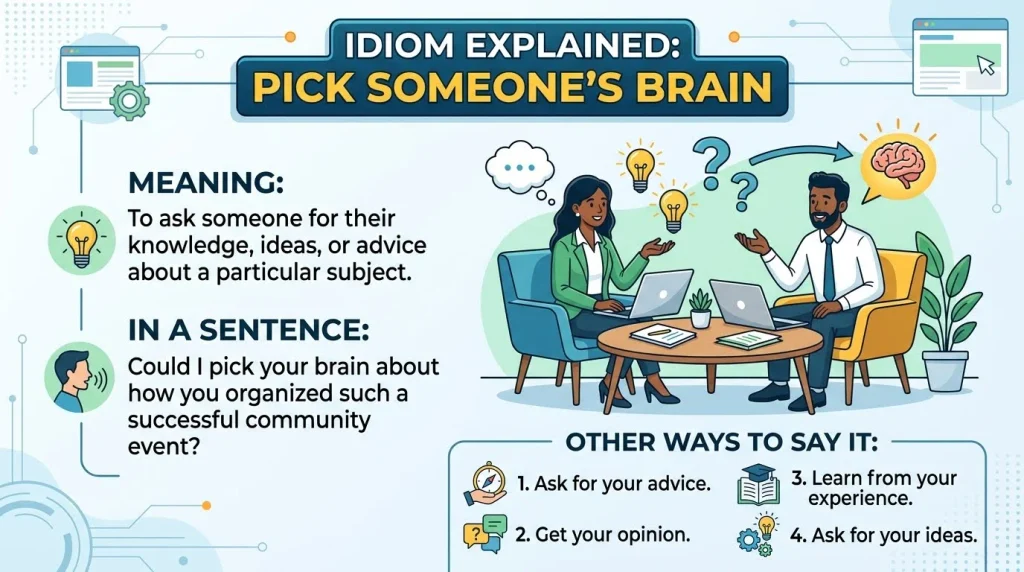
“Pick someone’s brain” means to ask someone for their knowledge, ideas, or advice about a particular subject.
In a Sentence
Could I pick your brain about how you organized such a successful community event?
Other Ways to Say It
- Ask for your advice.
- Get your opinion.
- Learn from your experience.
- Ask for your ideas.
Explanation
The expression uses a striking but non-literal image of accessing someone’s brain for useful knowledge. It usually suggests respect for another person’s experience or expertise.
Although the imagery sounds unusual when taken literally, the idiom is well understood in informal English.
Best Use
It works especially well in workplace conversations, networking, mentoring, education, and friendly discussions. It is informal rather than highly professional.
Have Something on Your Mind
Meaning
“Have something on your mind” means to be thinking about something repeatedly, often because it is important, worrying, or emotionally significant.
In a Sentence
You seem distracted today; is something on your mind?
Other Ways to Say It
- Be thinking about something.
- Have a concern.
- Be preoccupied.
- Have something bothering you.
Explanation
The idiom treats the mind as a place where thoughts can sit and remain. It often carries an emotional or concerned tone, although the thought does not necessarily have to be negative.
It is useful when describing a thought that continues to occupy someone’s attention.
Best Use
This expression fits naturally in conversations, personal messages, stories, and emotional writing.
Read Between the Lines
Meaning
“Read between the lines” means to look beyond the obvious words and understand an implied or hidden meaning.
In a Sentence
The email sounded polite, but if you read between the lines, you can tell that the manager was disappointed.
Other Ways to Say It
- Look for the hidden meaning.
- Interpret the implication.
- Look beyond the words.
- Notice what is implied.
Explanation
The “lines” represent the words that are directly written or spoken. Reading between them suggests finding the unstated message underneath.
This idiom is especially useful when communication is indirect and the real meaning depends on context, tone, or implication.
Best Use
Use it in conversations, literary analysis, communication advice, storytelling, and essays. It can describe both thoughtful interpretation and suspicion, depending on context.
See the Bigger Picture
Meaning
“See the bigger picture” means to understand the larger situation instead of focusing only on small details.
In a Sentence
The missed deadline was frustrating, but we need to see the bigger picture and consider how much progress the team has made.
Other Ways to Say It
- Look at the whole situation.
- Consider the wider context.
- Take a broader view.
- Look beyond the details.
Explanation
The expression compares understanding to looking at a large picture rather than staring at one tiny section. It encourages perspective and balanced thinking.
It can be especially valuable when emotions or small problems make it difficult to recognize the overall situation.
Best Use
It works well in workplace discussions, essays, speeches, advice, leadership writing, and everyday conversations.
A Light-Bulb Moment
Meaning
“A light-bulb moment” describes a sudden moment when someone understands something or discovers an idea.
In a Sentence
I had a light-bulb moment while reviewing the notes and finally understood how the two theories were connected.
Other Ways to Say It
- A sudden realization.
- An aha moment.
- A breakthrough.
- A moment of insight.
Explanation
The image comes from a light suddenly appearing, representing an idea or realization becoming clear. It captures the satisfying feeling of understanding something that was previously confusing.
The expression is vivid and easy to visualize, which makes it popular in informal communication.
Best Use
It is ideal for education, presentations, storytelling, social media, creative writing, and informal conversations.
Get Your Head Around Something
Meaning
“Get your head around something” means to understand something that is complicated, unfamiliar, or difficult to grasp.
In a Sentence
It took me a few days to get my head around the new software, but now I can use it confidently.
Other Ways to Say It
- Understand it.
- Grasp the idea.
- Make sense of it.
- Figure it out.
Explanation
The phrase gives the impression of mentally positioning yourself around a difficult concept until you can understand it. It communicates the effort involved in gaining comprehension.
The idiom is especially natural when a subject initially feels confusing or unfamiliar.
Best Use
This is common in everyday conversation, workplace communication, education, and informal explanations. It is more conversational than academic.
Wrap Your Head Around Something
Meaning
“Wrap your head around something” means to understand or accept a difficult, surprising, or complicated idea.
In a Sentence
I’m still trying to wrap my head around how quickly the situation changed.
Other Ways to Say It
- Try to understand it.
- Come to terms with it.
- Grasp the concept.
- Make sense of it.
Explanation
The mental image is unusual: it suggests surrounding a difficult idea with your mind until you can fully grasp it. That makes the expression particularly good for complex or surprising information.
It can also suggest emotional difficulty when someone struggles to accept what has happened.
Best Use
Use it in conversations, personal writing, storytelling, and informal explanations. Its casual tone makes it less appropriate for formal reports.
Think on Your Feet
Meaning
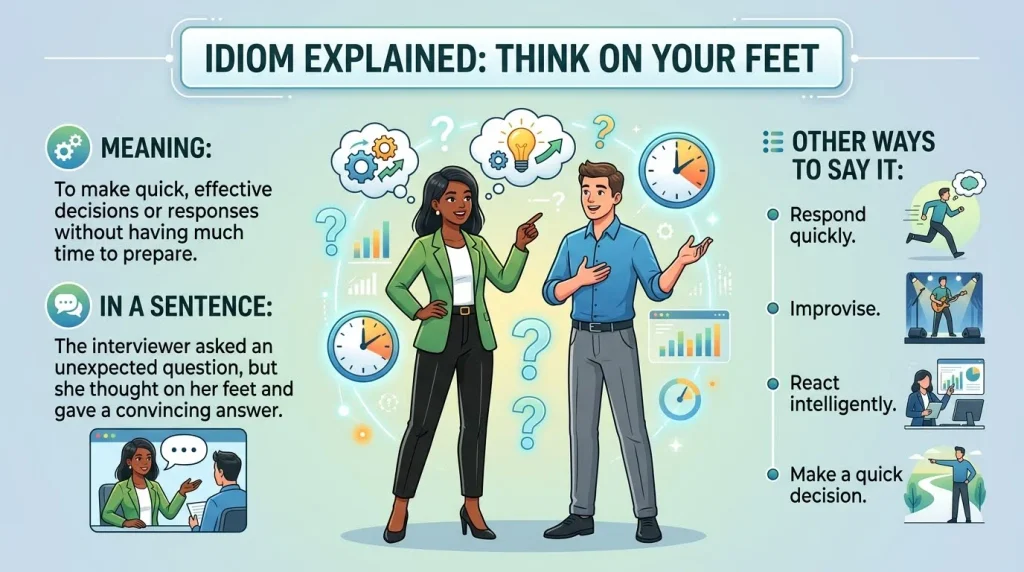
“Think on your feet” means to make quick, effective decisions or responses without having much time to prepare.
In a Sentence
The interviewer asked an unexpected question, but she thought on her feet and gave a convincing answer.
Other Ways to Say It
- Respond quickly.
- Improvise.
- React intelligently.
- Make a quick decision.
Explanation
The idiom connects thinking with being physically upright and ready to move. It creates an image of someone who can adapt mentally while a situation is unfolding.
Unlike idioms about deep reflection, this one emphasizes speed, flexibility, and presence of mind.
Best Use
It works especially well in workplace discussions, interviews, speeches, storytelling, and descriptions of problem-solving under pressure.
Lose Your Train of Thought
Meaning
“Lose your train of thought” means to forget what you were thinking or saying, often because you became distracted or interrupted.
In a Sentence
I was explaining my idea when the phone rang, and I completely lost my train of thought.
Other Ways to Say It
- Forget what you were saying.
- Become distracted.
- Lose your focus.
- Forget your point.
Explanation
The idiom compares a sequence of thoughts to a train traveling along a track. Losing the train means the chain of ideas has suddenly disappeared.
It is an effective way to describe a temporary interruption in concentration.
Best Use
This is natural in everyday conversations, presentations, classroom situations, and storytelling. Its tone is informal and relatable.
Go Over Something in Your Head
Meaning
“Go over something in your head” means to think about something repeatedly, often reviewing details or replaying an event mentally.
In a Sentence
Before making the decision, I went over the conversation in my head several times.
Other Ways to Say It
- Replay it mentally.
- Review it in your mind.
- Think it through.
- Reconsider what happened.
Explanation
The expression suggests mentally revisiting information, almost as though you were reviewing a recording. It can describe careful preparation, reflection, or repeated thinking.
Depending on context, it may sound calm and thoughtful or suggest that someone is dwelling on an event.
Best Use
It is useful in personal writing, storytelling, conversations, reflective essays, and descriptions of decision-making.
Change Your Mind
Meaning
“Change your mind” means to form a different opinion, decision, or intention from the one you had previously.
In a Sentence
I originally planned to stay home, but after hearing everyone’s plans, I changed my mind.
Other Ways to Say It
- Reconsider your decision.
- Take a different view.
- Alter your opinion.
- Decide differently.
Explanation
Unlike some highly figurative idioms, this expression is relatively transparent. The “change” refers to a shift in thought, opinion, or decision.
It is useful because it acknowledges that thinking is not always fixed; people can receive new information and revise their views.
Best Use
This phrase is appropriate for everyday conversation, workplace communication, essays, and personal writing. It is neutral and widely understandable.
A Lot on Your Plate
Meaning
“A lot on your plate” means having many responsibilities, tasks, or problems to deal with at the same time.
In a Sentence
I’d love to help with the project, but I already have a lot on my plate this week.
Other Ways to Say It
- Have a lot to handle.
- Be very busy.
- Have many responsibilities.
- Be dealing with several things.
Explanation
The image comes from a plate filled with more food than one person can comfortably manage. Figuratively, the “food” becomes tasks and responsibilities competing for your attention.
Because a crowded schedule can affect concentration, this expression can indirectly describe the mental pressure surrounding thinking and decision-making.
Best Use
It is particularly natural in workplace conversations, personal messages, everyday speech, and informal writing.
Second-Guess Yourself
Meaning
“Second-guess yourself” means to doubt your own decision, judgment, or original choice after making it.
In a Sentence
Once I submitted the application, I started to second-guess myself and wonder whether I had chosen the right answer.
Other Ways to Say It
- Doubt your decision.
- Question your judgment.
- Reconsider your choice.
- Have second thoughts.
Explanation
The phrase suggests mentally returning to a decision and asking whether you should have made a different one. It captures uncertainty and self-doubt rather than ordinary reflection.
It can be useful when describing the emotional side of thinking, particularly after an important choice.
Best Use
This idiom works well in personal writing, conversations, storytelling, advice, and reflective pieces. It usually carries a slightly anxious or uncertain tone.
Exercise: Practice Using Idioms
Choose the best answer for each question.
Which idiom means to think about something carefully before making a decision?
A. Lose your train of thought
B. Give it some thought
C. Pick someone’s brain
D. Think on your feet
Which expression describes a sudden moment of understanding?
A. A light-bulb moment
B. A lot on your plate
C. Second-guess yourself
D. Read between the lines
If someone connects clues and reaches a logical conclusion, which idiom fits best?
A. Think outside the box
B. Ponder over it
C. Put two and two together
D. Have something on your mind
What does “rack your brain” suggest?
A. Relaxing without thinking
B. Thinking very hard
C. Changing your opinion
D. Asking another person for advice
Which idiom means to understand an implied message?
A. See the bigger picture
B. Read between the lines
C. Put your thinking cap on
D. Give it some thought
Which expression is best for someone who must respond quickly to an unexpected situation?
A. Think on your feet
B. Go over something in your head
C. Food for thought
D. Have something on your mind
What does “food for thought” refer to?
A. A meal eaten while studying
B. A confusing argument
C. An idea worth considering
D. A decision made quickly
Which idiom describes having many responsibilities at once?
A. A lot on your plate
B. A light-bulb moment
C. Change your mind
D. Read between the lines
If you “lose your train of thought,” what happened?
A. You solved a difficult problem.
B. You forgot the direction of your thoughts.
C. You changed someone else’s opinion.
D. You understood a hidden message.
Which idiom encourages creative or unconventional thinking?
A. Think outside the box
B. Second-guess yourself
C. Pick someone’s brain
D. Have something on your mind
What does “pick someone’s brain” mean?
A. Challenge someone to a debate
B. Ask someone for knowledge or ideas
C. Interrupt someone’s concentration
D. Correct someone’s mistake
Which expression means to understand a difficult or unfamiliar concept?
A. Change your mind
B. See the bigger picture
C. Wrap your head around something
D. Lose your train of thought
Which idiom suggests doubting your own decision afterward?
A. Give it some thought
B. Second-guess yourself
C. Think on your feet
D. Put two and two together
Which statement uses “see the bigger picture” correctly?
A. I saw the bigger picture because the photograph was large.
B. She used the bigger picture to sharpen her pencil.
C. We need to consider the entire situation, not just this one problem.
D. He bought a bigger picture for his office.
Which phrase is most clearly figurative rather than literal?
A. Read between the lines
B. Write three lines
C. Read the first line
D. Draw a straight line
Answers
- B — “Give it some thought” means to consider something carefully before deciding.
- A — “A light-bulb moment” describes a sudden realization or insight.
- C — “Put two and two together” means to connect information and reach a conclusion.
- B — “Rack your brain” describes making a strong mental effort to remember or solve something.
- B — “Read between the lines” means to understand an implied or hidden meaning.
- A — “Think on your feet” means to respond effectively without much preparation time.
- C — “Food for thought” refers to an idea or point that deserves consideration.
- A — “A lot on your plate” means having many responsibilities or concerns to manage.
- B — “Lose your train of thought” means to forget what you were thinking or saying.
- A — “Think outside the box” encourages unconventional or creative approaches.
- B — “Pick someone’s brain” means to ask them for their knowledge, experience, or ideas.
- C — “Wrap your head around something” means to understand something difficult or complicated.
- B — “Second-guess yourself” means to doubt your own decision or judgment.
- C — The statement focuses on considering the whole situation rather than one isolated problem.
- A — “Read between the lines” is figurative because it refers to discovering meaning that is not directly stated.
FAQs
What is an idiom for thinking?
An idiom for thinking is a figurative expression used to describe mental activity, reasoning, ideas, concentration, understanding, or decision-making. Examples include “think outside the box,” “rack your brain,” and “give it some thought.”
How do I create my own idiom?
Start with a clear idea you want to express, such as confusion, creativity, or deep reflection. Then connect that idea to a strong mental image. The comparison should be easy to understand and should communicate more than a plain synonym.
What makes an idiom effective?
An effective idiom creates a clear image, communicates a recognizable idea, and sounds natural in context. Good figurative language should make the reader understand the intended feeling or concept rather than leave them confused.
Can I use these idioms in everyday conversation?
Yes. Many of these expressions, including “give it some thought,” “think on your feet,” “have something on your mind,” and “change your mind,” are natural in everyday English. More literary expressions may work better in creative or reflective writing.
What is the difference between an idiom and a simile?
An idiom has an established figurative meaning, such as “think outside the box.” A simile directly compares two things using words such as “like” or “as.” For example, “His thoughts moved like a rushing river” is a simile rather than a conventional idiom.
Conclusion
Thinking can take many forms: we can reason, reflect, imagine, question, remember, decide, and understand. The right idiom helps turn these invisible mental processes into language that readers and listeners can picture.
Expressions such as “a light-bulb moment” highlight sudden understanding, while “second-guess yourself” captures uncertainty. “Think outside the box” emphasizes creativity, and “see the bigger picture” encourages perspective. Each expression carries its own tone and emotional shade.
The best idiom depends on what you actually want to communicate. Choose one that matches the situation rather than using figurative language simply for decoration. When the image fits the idea naturally, an ordinary thought can become clearer, more memorable, and more expressive.

Oliver Whitcombe is a British writer and language enthusiast who has been fascinated by English expressions since childhood, when his grandmother told him he was “born with a silver spoon” and he spent a week trying to find it.
He created Idiom Looms to help learners and native speakers alike make sense of English idioms. Their origins, their meanings, and the moments they’re best used. His writing mixes plain explanations with a good dose of British wit.
Oliver lives in England, where he divides his time between writing, walking, and correcting everyone’s grammar (politely).



[…] Read more:20 Idioms for Thinking With Real Examples […]