

Have you ever noticed how naturally clever people express ideas and solve problems? 20 Idioms for Smart Person With Real Examples introduces useful expressions for describing intelligence, wisdom, cleverness, and quick thinking. These idioms can make everyday English more vivid while helping you express ideas with greater confidence.
In this guide, you’ll discover 20 practical idioms with clear meanings and natural examples. You’ll also learn how context, English usage, and grammar influence their meaning. These expressions can strengthen business communication, conversations, formal writing, meetings, and other situations where clear language matters.
From describing sharp thinking to recognizing someone’s good judgment, each idiom adds a different shade of meaning. The examples make these phrases easier to remember and use with consistency. Whether you’re learning English or improving your writing, this guide helps you choose smart, natural expressions for different contexts.
What Is an Idiom?
An idiom is a fixed expression whose meaning is different from the literal meaning of its individual words. Idioms often use imagery to communicate an idea in a memorable way.
For example, “break the ice” does not mean physically breaking ice. It means to make people feel more comfortable in a social situation. Likewise, “hit the nail on the head” means to identify something exactly or correctly.
A literal statement gives its meaning directly, while an idiom uses figurative language and shared meaning to make an idea more expressive.
Why Use Idioms for Smart Person?
Idioms can make a description of an intelligent person much more specific. Instead of simply saying someone is smart, you can show what kind of intelligence they have.
For example, “quick on the uptake” suggests that someone understands things quickly, while “know your onions” suggests strong knowledge of a particular subject. “See the big picture” points toward strategic or broad thinking.
These expressions can help you:
- Express admiration without sounding repetitive.
- Make descriptions more vivid and memorable.
- Show different forms of intelligence, such as observation, learning ability, reasoning, or creativity.
- Add personality to conversations and storytelling.
- Make essays and creative writing more expressive.
- Communicate complicated ideas about intelligence in a short phrase.
Quick List of 20 Idioms
- Sharp as a tack
- Quick on the uptake
- Have a good head on your shoulders
- Have your wits about you
- Have a mind like a steel trap
- Know your onions
- Put two and two together
- Think outside the box
- Ahead of the curve
- A bright spark
- An old head on young shoulders
- Wise beyond your years
- A quick study
- Have an eye for detail
- See the big picture
- Join the dots
- Read between the lines
- Catch on quickly
- A whiz at something
- Hit the nail on the head
Sharp as a Tack
Read more:20 Idioms for Pictures With Real Examples
Meaning
“Sharp as a tack” describes someone who is very alert, intelligent, and quick-thinking. The comparison suggests a mind that is as sharp as the pointed end of a tack.
In a Sentence
Even at eighty, Grandpa is sharp as a tack and remembers every detail of family conversations.
Other Ways to Say It
- Very quick-minded
- Mentally sharp
- Extremely alert
- Quick-witted
Explanation
The image of a sharp tack makes the expression easy to remember. It suggests a person whose mind works quickly and clearly.
This is a friendly, informal expression and often works especially well when praising someone’s mental alertness.
Best Use
Best for conversations, personal stories, storytelling, and informal writing. It can sound too casual for highly formal academic writing.
Quick on the Uptake
Meaning
“Quick on the uptake” means someone understands new information or ideas quickly.
In a Sentence
Maya was quick on the uptake, so she understood the complicated instructions after hearing them only once.
Other Ways to Say It
- Learns quickly
- Grasps ideas fast
- Fast to understand
- Picks things up quickly
Explanation
The expression focuses less on general intelligence and more on speed of understanding. It is useful when someone immediately grasps what another person is explaining.
It creates the impression of a learner who does not need repeated explanations.
Best Use
Ideal for workplace conversations, classroom descriptions, storytelling, and everyday speech.
Have a Good Head on Your Shoulders
Meaning
To “have a good head on your shoulders” means to be sensible, intelligent, practical, and capable of making good decisions.
In a Sentence
He may be young, but he has a good head on his shoulders and knows how to handle difficult situations.
Other Ways to Say It
- Sensible and capable
- Good judgment
- Level-headed
- Practical thinker
Explanation
This expression combines intelligence with sound judgment. It does not simply praise someone’s ability to solve puzzles; it suggests they can use good sense in real life.
It is especially useful when describing someone dependable and mature.
Best Use
Works well in conversations, personal recommendations, character descriptions, and professional contexts.
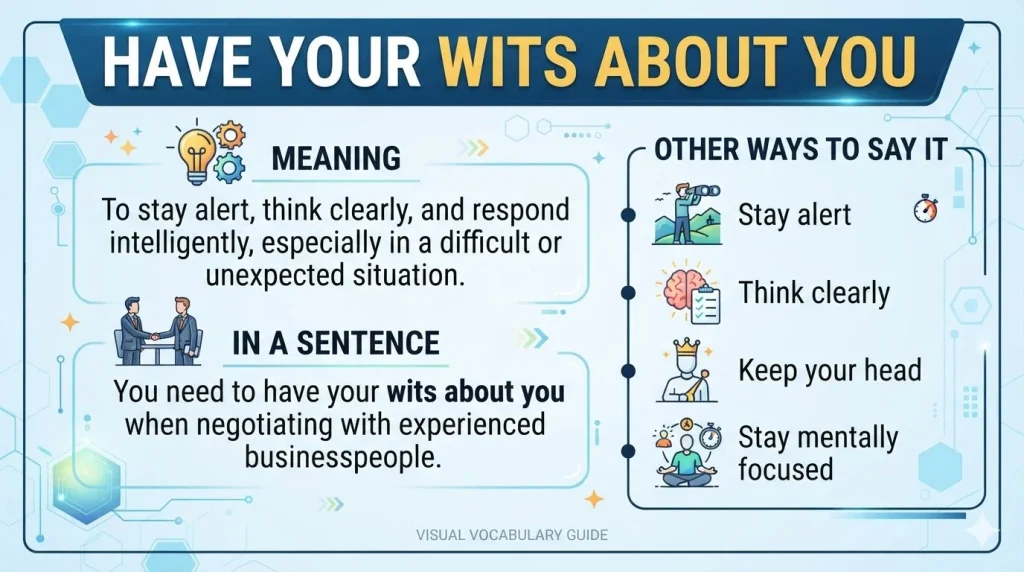
Have Your Wits About You
Meaning
To “have your wits about you” means to stay alert, think clearly, and respond intelligently, especially in a difficult or unexpected situation.
In a Sentence
You need to have your wits about you when negotiating with experienced businesspeople.
Other Ways to Say It
- Stay alert
- Think clearly
- Keep your head
- Stay mentally focused
Explanation
This expression emphasizes presence of mind rather than academic intelligence. Someone with their wits about them can react sensibly when circumstances become challenging.
It can also suggest practical intelligence and awareness.
Best Use
Useful in advice, conversations, stories, speeches, and situations involving pressure or uncertainty.
Have a Mind Like a Steel Trap
Meaning
“Have a mind like a steel trap” describes someone with an excellent memory who remembers information very accurately.
In a Sentence
Mr. Khan has a mind like a steel trap; he can recall names and dates from meetings years ago.
Other Ways to Say It
- Have an excellent memory
- Remember everything
- Have a remarkable memory
- Never forget a detail
Explanation
The image of a steel trap suggests something that holds firmly and does not let go. Here, the idea is that information stays firmly in someone’s memory.
This expression is particularly effective when someone’s intelligence is connected to their ability to remember details.
Best Use
Best for personal descriptions, storytelling, conversations, and character writing.
Know Your Onions
Meaning
To “know your onions” means to be very knowledgeable or competent in a particular subject or area.
In a Sentence
Ask Daniel about cameras—he knows his onions when it comes to photography equipment.
Other Ways to Say It
- Know your stuff
- Be knowledgeable
- Know the subject well
- Be an expert in the area
Explanation
This is an informal British expression. Its playful wording makes it sound lighter than simply calling someone knowledgeable.
It works particularly well when praising practical expertise rather than general intelligence.
Best Use
Use it mainly in informal conversation, British English, humorous writing, and friendly descriptions.
Put Two and Two Together
Meaning
To “put two and two together” means to use available information to reach a logical conclusion.
In a Sentence
When Lena noticed the missing keys and the open garage door, she put two and two together and realized someone had moved the car.
Other Ways to Say It
- Make the connection
- Work it out
- Draw a conclusion
- Connect the clues
Explanation
The expression uses simple arithmetic as a metaphor for logical reasoning. It is especially useful when someone notices separate facts and understands how they are connected.
It can describe intelligence without directly calling someone clever.
Best Use
Excellent for stories, mysteries, conversations, essays, and explanations of logical thinking.
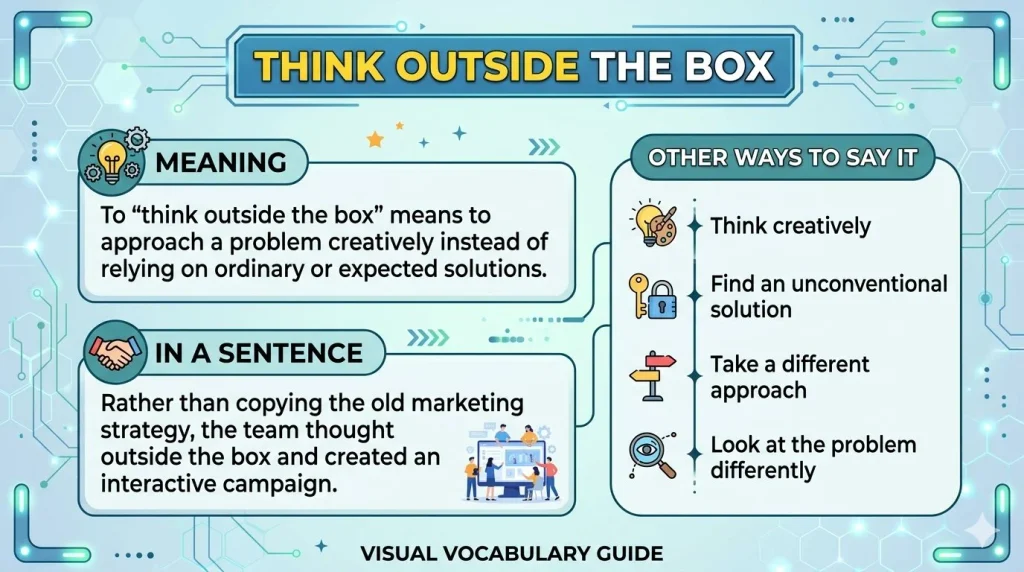
Think Outside the Box
Meaning
To “think outside the box” means to approach a problem creatively instead of relying on ordinary or expected solutions.
In a Sentence
Rather than copying the old marketing strategy, the team thought outside the box and created an interactive campaign.
Other Ways to Say It
- Think creatively
- Find an unconventional solution
- Take a different approach
- Look at the problem differently
Explanation
The “box” represents familiar limits or conventional thinking. Stepping outside it creates an image of someone willing to challenge assumptions and explore new possibilities.
The expression is about creative intelligence rather than memory or academic knowledge.
Best Use
Especially effective in business writing, presentations, brainstorming, essays, and professional conversations.
Ahead of the Curve
Meaning
Being “ahead of the curve” means being more advanced, knowledgeable, or prepared than others in a particular area.
In a Sentence
Priya was ahead of the curve and had already learned the software before her company introduced it.
Other Ways to Say It
- Ahead of the competition
- Highly advanced
- Forward-thinking
- Leading the way
Explanation
The “curve” represents the general level of progress. Someone ahead of it is moving faster or thinking further ahead than others.
It often suggests intelligence combined with awareness, preparation, or innovation.
Best Use
Best for professional writing, business discussions, technology, education, and achievement-focused descriptions.
A Bright Spark
Meaning
A “bright spark” is an intelligent or clever person, often someone who has an impressive idea or shows quick thinking.
In a Sentence
One bright spark in the class suggested turning the unused room into a student study area.
Other Ways to Say It
- Clever person
- Quick thinker
- Bright mind
- Intelligent individual
Explanation
The word “bright” suggests intelligence, while “spark” creates an image of energy and sudden inspiration.
The expression can be genuinely complimentary, although in some contexts it may be used playfully or sarcastically depending on tone.
Best Use
Works well in informal conversation, classroom settings, storytelling, and lighthearted writing.
An Old Head on Young Shoulders
Meaning
“An old head on young shoulders” describes a young person who shows unusual wisdom, maturity, and good judgment.
In a Sentence
Although Amir is only sixteen, he has an old head on young shoulders and gives remarkably thoughtful advice.
Other Ways to Say It
- Mature for their age
- Remarkably wise
- Wise beyond their age
- Mature and sensible
Explanation
The expression creates a striking contrast between youthful appearance and mature thinking. It suggests that someone’s judgment seems much older than their actual age.
It is often warm and admiring rather than purely intellectual.
Best Use
Ideal for personal stories, character descriptions, speeches, and thoughtful conversations.
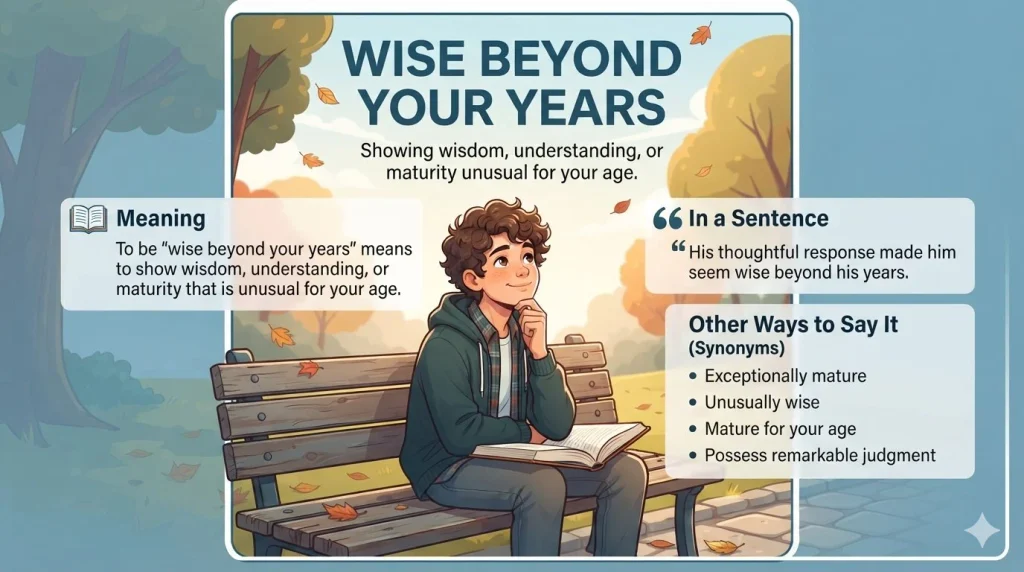
Wise Beyond Your Years
Meaning
To be “wise beyond your years” means to show wisdom, understanding, or maturity that is unusual for your age.
In a Sentence
His thoughtful response made him seem wise beyond his years.
Other Ways to Say It
- Exceptionally mature
- Unusually wise
- Mature for your age
- Possess remarkable judgment
Explanation
This phrase focuses on wisdom rather than raw intelligence. Someone can be academically gifted without being wise, so this expression communicates a different quality.
It often carries a warm, respectful, or inspirational tone.
Best Use
Strong for speeches, personal messages, creative writing, biographies, and character descriptions.
A Quick Study
Meaning
A “quick study” is someone who learns a new skill, task, or subject quickly.
In a Sentence
She had never used the design program before, but she was a quick study and became comfortable with it within a few days.
Other Ways to Say It
- Fast learner
- Quick learner
- Learns rapidly
- Picks up skills quickly
Explanation
This expression highlights learning ability. It is particularly useful when someone encounters something unfamiliar and becomes competent in a short time.
Unlike some expressions on this list, it is often suitable for professional settings.
Best Use
Excellent for job interviews, workplace descriptions, resumes, recommendations, and everyday conversation.
Have an Eye for Detail
Meaning
To “have an eye for detail” means to be especially good at noticing small but important features or mistakes.
In a Sentence
Our editor has an eye for detail and spotted the tiny error before the report was published.
Other Ways to Say It
- Notice small details
- Be detail-oriented
- Have a keen eye
- Spot subtle differences
Explanation
The “eye” represents careful observation. The expression suggests that someone’s intelligence is partly shown through their ability to notice what others overlook.
It is especially useful when describing analytical, editorial, artistic, or professional skills.
Best Use
Best for workplace writing, essays, recommendations, design discussions, editing, and professional conversations.
See the Big Picture
Meaning
To “see the big picture” means to understand the overall situation instead of focusing only on small details.
In a Sentence
A strong manager needs to see the big picture before making decisions about individual projects.
Other Ways to Say It
- Understand the overall situation
- Think strategically
- Look at the wider context
- See the larger goal
Explanation
The expression creates a visual contrast between a small detail and a complete picture. It describes broad, strategic thinking.
Someone who sees the big picture can understand how individual choices affect a larger goal.
Best Use
Especially useful in business, leadership, essays, presentations, planning, and serious discussions.
Join the Dots
Meaning
To “join the dots” means to connect separate pieces of information and understand the larger meaning or relationship between them.
In a Sentence
After reviewing the customer complaints, the manager joined the dots and discovered that all the problems came from the same process.
Other Ways to Say It
- Connect the clues
- See the connection
- Link the information
- Make sense of the evidence
Explanation
The expression comes from the image of connecting separate dots to reveal a complete picture. It highlights pattern recognition and analytical thinking.
It can be particularly powerful when describing someone who notices relationships that other people miss.
Best Use
Works well in business discussions, investigative writing, storytelling, journalism, and analytical essays.
Read Between the Lines
Meaning
To “read between the lines” means to understand a hidden, indirect, or unstated meaning in someone’s words.
In a Sentence
You have to read between the lines to understand what the email is really asking for.
Other Ways to Say It
- Detect the hidden meaning
- Look beyond the words
- Understand the implication
- Pick up on subtle clues
Explanation
The “lines” represent the words that are actually written or spoken, while the space between them represents what is implied but not directly stated.
This expression portrays someone as perceptive and socially or intellectually observant.
Best Use
Useful in conversations, literature analysis, storytelling, essays, workplace communication, and social situations.
Catch On Quickly
Meaning
To “catch on quickly” means to understand a new idea, system, skill, or situation without needing much explanation.
In a Sentence
The new employee caught on quickly and was handling the system confidently by the end of her first week.
Other Ways to Say It
- Learn quickly
- Understand fast
- Pick things up rapidly
- Grasp the idea quickly
Explanation
This expression presents intelligence through adaptability and fast learning. It is especially appropriate when someone enters a new situation and becomes comfortable quickly.
It is more conversational than some formal alternatives.
Best Use
Great for everyday speech, workplace conversations, classroom settings, and informal writing.
A Whiz at Something
Meaning
To be “a whiz at something” means to be extremely skilled or clever at a particular activity or subject.
In a Sentence
Nadia is a whiz at mathematics, so everyone asks her for help before an exam.
Other Ways to Say It
- Extremely good at something
- Highly skilled
- Very talented
- Excellent at the subject
Explanation
“Whiz” is informal and energetic, giving the expression a sense of impressive ability. It normally works best when the person’s intelligence is connected to a particular skill.
It is more natural to say “a whiz at math” than simply “a whiz” in many situations.
Best Use
Best for casual conversation, school settings, friendly descriptions, and informal writing.
Hit the Nail on the Head
Meaning
To “hit the nail on the head” means to identify or explain something exactly and correctly.
In a Sentence
When Carlos said the real problem was poor communication, he hit the nail on the head.
Other Ways to Say It
- Get it exactly right
- Identify the real issue
- Be exactly right
- Pinpoint the problem
Explanation
The literal image is of striking a nail precisely where it needs to be struck. Figuratively, it describes accuracy of thought or judgment.
It does not necessarily mean someone is generally intelligent; instead, it praises a particular insight or observation.
Best Use
Useful in conversations, meetings, essays, speeches, reviews, and analytical writing.
Exercise: Practice Using Idioms
Choose the best answer for each question.
What does “sharp as a tack” usually suggest about a person?
A. Showing physical strength
B. Demonstrating intelligence and alertness
C. Remaining extremely quiet
D. Appearing difficult to approach
Which expression describes someone who learns new things very quickly?
A. See the big picture
B. Know your onions
C. A quick study
D. Read between the lines
What does “have a good head on your shoulders” emphasize?
A. Good judgment and practical sense
B. Strong physical health
C. Excellent artistic ability
D. A powerful speaking voice
If someone “puts two and two together,” what are they doing?
A. Repeating information
B. Avoiding a difficult question
C. Memorizing facts
D. Reaching a logical conclusion
Which expression is most closely connected with creative problem-solving?
A. Have your wits about you
B. Think outside the box
C. Have an eye for detail
D. Catch on quickly
What does “know your onions” mean?
A. You enjoy cooking.
B. You remember people’s names.
C. You are knowledgeable about a subject.
D. You prefer working alone.
Which expression best describes a young person who behaves with unusual maturity?
A. A bright spark
B. A quick study
C. A whiz at something
D. An old head on young shoulders
Someone who “has an eye for detail” is especially good at:
A. Noticing small but important things
B. Making quick speeches
C. Predicting the future
D. Making people laugh
What does “see the big picture” mean?
A. Notice every tiny error
B. Understand the overall situation
C. Memorize large amounts of information
D. Avoid making decisions
If a person can “read between the lines,” they can:
A. Read very quickly
B. Write without mistakes
C. Understand hidden or implied meanings
D. Remember every sentence
What does “ahead of the curve” generally suggest?
A. Being more advanced or prepared than others
B. Being physically faster
C. Working fewer hours
D. Avoiding competition
Which expression focuses most directly on excellent memory?
A. Join the dots
B. Have a mind like a steel trap
C. Think outside the box
D. Hit the nail on the head
If someone “catches on quickly,” what happens?
A. They become distracted.
B. They forget instructions.
C. They understand something rapidly.
D. They change their opinion.
Which expression praises someone for making an exactly correct observation?
A. Hit the nail on the head
B. A bright spark
C. Know your onions
D. See the big picture
Which statement correctly distinguishes “wise beyond your years” from “a quick study”?
A. Describing physical strength in the first; memory in the second
B. Suggesting unusual maturity in the first; fast learning in the second
C. Indicating creativity in the first; careful observation in the second
D. Referring to professional skill in the first; broad thinking in the second
Answers
- B — “Sharp as a tack” describes someone who is mentally sharp, alert, and intelligent.
- C — A “quick study” is someone who learns a new subject or skill quickly.
- A — Having a good head on your shoulders suggests sensible thinking and good judgment.
- D — “Put two and two together” means connecting facts to reach a logical conclusion.
- B — “Think outside the box” describes creative or unconventional problem-solving.
- C — “Know your onions” means to be knowledgeable or competent in a particular area.
- D — “An old head on young shoulders” describes a young person with unusually mature judgment.
- A — Someone with an eye for detail notices small features that others may miss.
- B — “See the big picture” means understanding the wider situation or overall goal.
- C — “Read between the lines” means recognizing meanings that are implied rather than directly stated.
- A — Being “ahead of the curve” suggests being more advanced, prepared, or progressive than others.
- B — A mind like a steel trap refers especially to having a strong and reliable memory.
- C — To “catch on quickly” means to understand a new idea or skill rapidly.
- A — “Hit the nail on the head” means identifying something exactly or correctly.
- B — “Wise beyond your years” focuses on unusual maturity or wisdom, while “a quick study” focuses on rapid learning.
FAQs
What is an idiom for Smart Person?
There are many expressions that can describe an intelligent person. “Sharp as a tack,” “quick on the uptake,” “a bright spark,” and “a quick study” are useful choices. The best expression depends on the particular type of intelligence you want to describe.
How do I create my own idiom for a smart person?
Start with the quality you want to describe, such as creativity, memory, wisdom, observation, or quick thinking. Then create a memorable comparison or image that communicates that quality. For established idioms, however, it is better to use expressions that already have a recognized meaning.
What makes an idiom effective?
An effective idiom creates a clear mental image while communicating an idea beyond its literal words. It should also fit the context naturally. A playful expression may work beautifully in conversation but feel inappropriate in a formal academic essay.
Can I use these idioms in everyday conversation?
Yes. Many of these expressions are natural in everyday English, especially “sharp as a tack,” “quick on the uptake,” “put two and two together,” and “catch on quickly.” More informal expressions, such as “know your onions” or “a whiz,” should be used when the tone allows it.
What is the difference between an idiom and a simile?
An idiom is an established expression with a figurative meaning, such as “hit the nail on the head.” A simile directly compares two things using words such as “like” or “as.” Some idioms may contain comparisons, but not every comparison is an idiom.
Conclusion
The English language offers far more interesting ways to describe a smart person than simply using words such as “intelligent” or “clever.” Expressions like “sharp as a tack” highlight mental sharpness, while “a quick study” focuses on learning ability and “read between the lines” emphasizes perception. Other expressions celebrate wisdom, creativity, memory, logical thinking, or careful observation.
The key is to choose an expression that matches the specific quality you want to communicate. A professional description may benefit from “a quick study,” while a friendly conversation may call for “a bright spark.” When used naturally, idioms give your writing and speech greater personality, imagery, and emotional detail. The strongest expression is not necessarily the fanciest one it is the one that helps your reader or listener see exactly what makes that smart person stand out.

Margaret Saywell is an English author and editor who has spent more than fifteen years working with words teaching, proofreading, and writing about the quirks of the English language.
At Idiom Looms, Margaret gathers idioms from across the English-speaking world and weaves them into clear, practical guides. She loves digging into the history of a phrase and showing readers how a few well-chosen words can say far more than a long explanation.
She believes language should be enjoyed, not feared and that the best way to learn an idiom is to see it in action.


[…] Read more:20 Idioms for Smart Person With Real Examples […]