

Have you ever struggled to express an adult idea without sounding too plain or predictable? 20 Idioms for Adults With Real Examples introduces natural expressions that make everyday English more vivid and precise. These idioms can strengthen business communication, conversations, formal writing, and practical English usage. They also help learners understand how context shapes grammar, tone, and meaning.
Adult communication often involves meetings, scheduling, time management, and project management. Even tasks involving a calendar, online booking, or broadcasting can benefit from clear, expressive language. This guide explains each idiom in simple terms, provides realistic examples, and shows when the expression sounds natural. You will also learn how these phrases support clarity, confidence, and consistency in communication.
Whether you are improving workplace English or refining everyday conversations, these expressions offer useful language choices. Each example focuses on practical context rather than forced keyword usage. By the end, you will better understand idiomatic meaning, tone, and figurative expression. You can then use these idioms naturally in conversations, messages, professional settings, and writing.
What Is an Idiom?
An idiom is a fixed expression whose intended meaning is different from its literal wording. People understand idioms based on common language and context rather than interpreting every word exactly as written.
For example:
- “Break the ice” means to make people feel more comfortable in a social situation.
- “Hit the nail on the head” means to identify or express something exactly.
If someone literally says, “He broke the ice,” you might imagine physical ice being smashed. In an idiomatic context, however, the phrase usually refers to starting a friendly interaction.
Idioms are useful because they turn ordinary ideas into memorable images.
Why Use Idioms for Adults?
Describing adults does not always mean simply saying someone is “mature” or “responsible.” Adulthood includes many different experiences, from independence and wisdom to pressure, uncertainty, resilience, and learning from mistakes.
Figurative expressions can help you:
- Express emotional maturity without sounding overly formal.
- Make descriptions of adults more vivid and memorable.
- Explain life experience through familiar imagery.
- Add personality to conversations and personal writing.
- Describe responsibility, independence, or resilience creatively.
- Communicate complicated feelings in a short, recognizable expression.
- Make essays, stories, speeches, and social posts more engaging.
The key is choosing an expression that matches the situation. Some idioms sound natural in everyday conversation, while others are more poetic, humorous, or dramatic.
Quick List of 20 Idioms for Adults
- Been around the block
- Have a lot on one’s plate
- Stand on one’s own two feet
- Keep one’s head above water
- Weather the storm
- Learn the hard way
- Bite the bullet
- Know the ropes
- Call the shots
- A shoulder to cry on
- Put one’s house in order
- Go the extra mile
- Keep one’s feet on the ground
- See the bigger picture
- Take the bull by the horns
- Have one’s act together
- Roll with the punches
- Burn the candle at both ends
- A breath of fresh air
- At a crossroads
Been Around the Block
Read more:20 Idioms for Thinking With Real Examples
Meaning
“Been around the block” describes someone who has experienced enough of life to become knowledgeable or worldly. It often suggests that a person has encountered different situations and learned from them.
In a Sentence
My uncle has been around the block a few times, so he knows how to handle difficult situations without panicking.
Other Ways to Say It
- Has plenty of life experience
- Knows a thing or two
- Has seen it all
- Is experienced in life
Explanation
The image comes from someone who has traveled the same neighborhood repeatedly and therefore knows it well. Applied to adults, the expression suggests practical experience rather than simply age.
It can sound respectful, humorous, or slightly cheeky depending on the context. It is particularly useful when describing someone who has learned from many real-life experiences.
Best Use
Best for conversations, storytelling, character descriptions, and informal writing. It is casual rather than highly professional.
Have a Lot on One’s Plate
Meaning
To “have a lot on one’s plate” means to have many responsibilities, problems, or tasks to deal with at the same time.
In a Sentence
Between managing the project, helping his parents, and raising two children, Daniel has a lot on his plate right now.
Other Ways to Say It
- Have a lot going on
- Carry many responsibilities
- Have a full schedule
- Be dealing with a lot
Explanation
The expression creates the image of a plate filled with more food than a person can easily manage. For adults, it captures the busy and demanding side of everyday life.
Unlike expressions that emphasize maturity, this one focuses on the number of responsibilities someone is carrying.
Best Use
Excellent for everyday conversations, workplace discussions, personal messages, and social media writing.
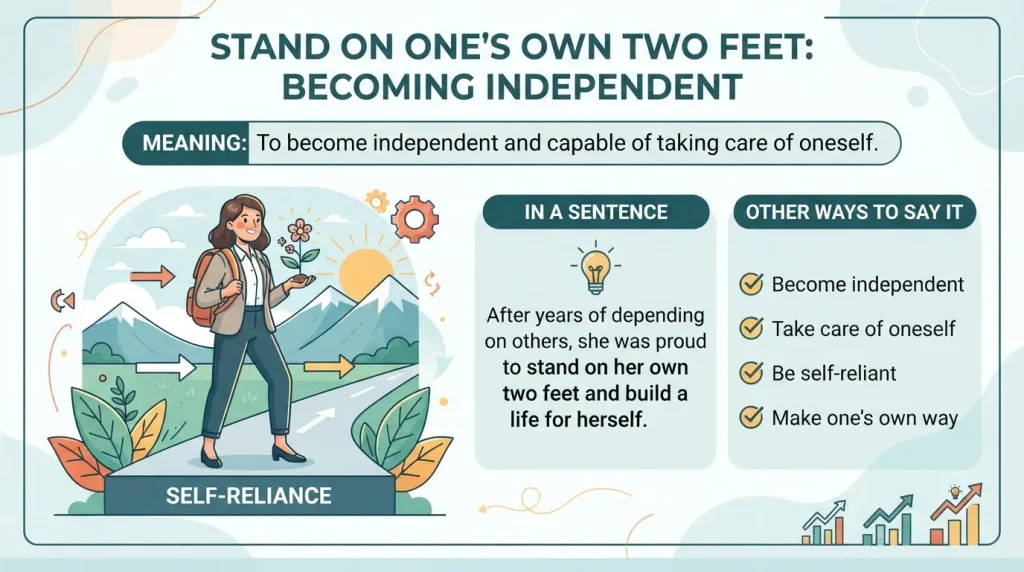
Stand on One’s Own Two Feet
Meaning
“Stand on one’s own two feet” means to become independent and capable of taking care of oneself.
In a Sentence
After years of depending on others, she was proud to stand on her own two feet and build a life for herself.
Other Ways to Say It
- Become independent
- Take care of oneself
- Be self-reliant
- Make one’s own way
Explanation
The image is simple: a person standing firmly without needing someone else to hold them up. For adults, it represents independence, confidence, and personal responsibility.
The expression often carries a positive sense of achievement, especially when someone has worked hard to become self-sufficient.
Best Use
Works especially well in personal stories, inspirational writing, speeches, and conversations about independence.
Keep One’s Head Above Water
Meaning
To “keep one’s head above water” means to manage a difficult situation without becoming overwhelmed.
In a Sentence
The past few months have been exhausting, but I’m keeping my head above water and taking things one day at a time.
Other Ways to Say It
- Stay afloat
- Manage under pressure
- Keep going
- Avoid being overwhelmed
Explanation
The expression compares life’s difficulties to deep water. Keeping your head above it means you are struggling but still managing to breathe and continue.
It can describe an adult dealing with work, finances, family responsibilities, or emotional pressure without suggesting that everything is easy.
Best Use
Natural in personal conversations, reflective writing, workplace discussions, and serious storytelling.
Weather the Storm
Meaning
To “weather the storm” means to survive a difficult period and remain strong until conditions improve.
In a Sentence
The company went through a difficult year, but the team worked together to weather the storm.
Other Ways to Say It
- Get through a difficult period
- Ride out the crisis
- Endure the hardship
- Come through a tough time
Explanation
The expression compares hardship to a powerful storm. An adult who weathers the storm does not necessarily avoid difficulty; instead, they remain steady while the difficulty passes.
It has a resilient and serious tone, making it stronger than a simple statement such as “get through a problem.”
Best Use
Particularly effective in speeches, motivational writing, serious conversations, and stories about resilience.
Learn the Hard Way
Meaning
To “learn the hard way” means to gain an important lesson through an unpleasant or difficult personal experience.
In a Sentence
I learned the hard way that ignoring small problems usually makes them much bigger.
Other Ways to Say It
- Learn from experience
- Find out through mistakes
- Learn from one’s errors
- Discover through experience
Explanation
Adults often make decisions without knowing exactly how things will turn out. This expression acknowledges that some lessons become memorable because they involve mistakes, consequences, or disappointment.
It can be self-reflective without being overly negative.
Best Use
Useful in conversations, personal essays, advice, storytelling, and reflective writing.
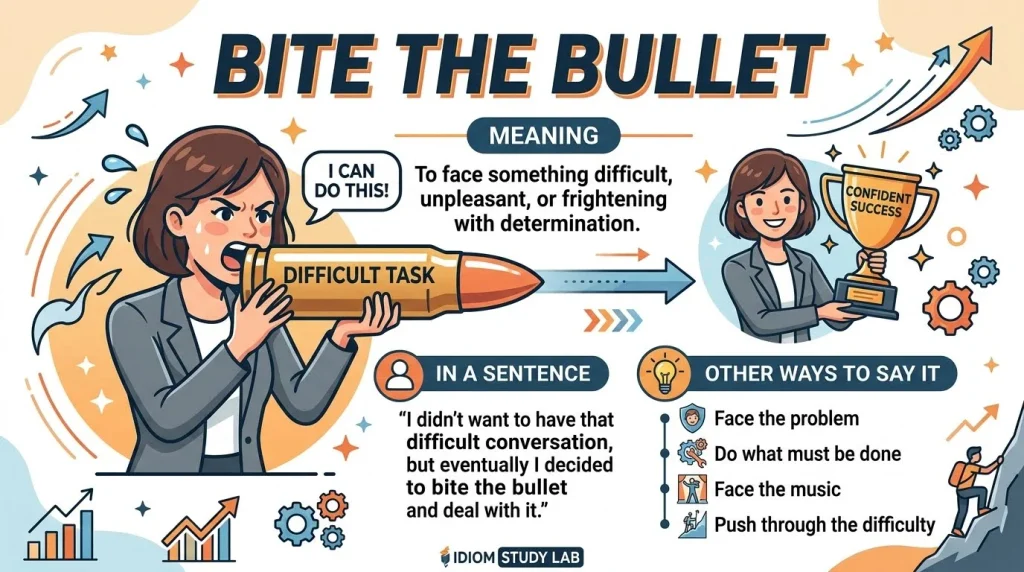
Bite the Bullet
Meaning
To “bite the bullet” means to face something difficult, unpleasant, or frightening with determination.
In a Sentence
I didn’t want to have that difficult conversation, but eventually I decided to bite the bullet and deal with it.
Other Ways to Say It
- Face the problem
- Do what must be done
- Face the music
- Push through the difficulty
Explanation
The phrase creates a dramatic image of someone enduring pain without backing away. For adults, it can represent the reality of making difficult decisions and handling uncomfortable responsibilities.
It is usually practical rather than sentimental.
Best Use
Best in casual conversation, advice, storytelling, and situations involving difficult decisions.
Know the Ropes
Meaning
To “know the ropes” means to understand how something works because of experience or training.
In a Sentence
Give Priya a few days with the new employee; she knows the ropes and can show him how everything works.
Other Ways to Say It
- Know how things work
- Be experienced
- Know the ins and outs
- Understand the system
Explanation
The expression is traditionally associated with learning the ropes needed to operate a ship. Today, it describes someone who has practical knowledge of a situation.
For adults, it is useful when emphasizing competence rather than age.
Best Use
Especially suitable for workplace conversations, mentoring, professional writing, and everyday speech.
Call the Shots
Meaning
To “call the shots” means to make the important decisions or control what happens.
In a Sentence
Once Maria became team leader, she was responsible for calling the shots on the major project decisions.
Other Ways to Say It
- Make the decisions
- Be in charge
- Take control
- Run the show
Explanation
The phrase comes from the idea of someone giving commands about what should happen. It portrays an adult as decisive, authoritative, or independent.
Depending on the situation, it can sound admiring or slightly critical if the person is perceived as overly controlling.
Best Use
Works well in conversations, workplace writing, storytelling, and informal descriptions of leadership.
A Shoulder to Cry On
Meaning
A “shoulder to cry on” is someone who provides emotional support and a sympathetic listener during difficult times.
In a Sentence
Even though he was dealing with his own problems, he was always a shoulder to cry on when his friends needed him.
Other Ways to Say It
- A source of comfort
- Someone to lean on
- A trusted listener
- Emotional support
Explanation
The expression creates the familiar image of someone resting their head on another person’s shoulder while upset. It highlights compassion, trust, and emotional availability.
It is warmer and more personal than simply calling someone “supportive.”
Best Use
Ideal for personal messages, conversations, relationship writing, storytelling, and emotional descriptions.
Put One’s House in Order
Meaning
To “put one’s house in order” means to organize one’s affairs and deal with important problems or responsibilities.
In a Sentence
Before starting a new chapter of his life, he decided to put his house in order and settle his outstanding responsibilities.
Other Ways to Say It
- Get one’s affairs in order
- Sort things out
- Organize one’s life
- Put things right
Explanation
The “house” represents a person’s life rather than a physical building. The expression suggests stepping back, identifying what needs attention, and bringing order to neglected responsibilities.
It has a thoughtful, serious tone and can imply both practical and personal organization.
Best Use
Strong for reflective writing, serious conversations, speeches, and life-transition stories.
Go the Extra Mile
Meaning
To “go the extra mile” means to make more effort than is normally expected.
In a Sentence
She always goes the extra mile for her clients, even when the extra work is not required.
Other Ways to Say It
- Make an extra effort
- Do more than expected
- Give it one’s all
- Put in extra work
Explanation
The image suggests continuing beyond the point where the required journey has already been completed. For adults, it can describe dedication, generosity, professionalism, or commitment.
The expression is generally positive and focuses on behavior rather than personality.
Best Use
Useful in professional writing, recommendations, speeches, conversations, and appreciation messages.
Keep One’s Feet on the Ground
Meaning
To “keep one’s feet on the ground” means to remain practical, realistic, and humble despite success or excitement.
In a Sentence
Even after receiving the promotion, he kept his feet on the ground and continued treating everyone with respect.
Other Ways to Say It
- Stay grounded
- Remain realistic
- Keep a level head
- Stay humble
Explanation
The expression contrasts being firmly on the ground with becoming carried away by success or unrealistic ideas.
It describes a valuable quality in adults who can handle achievement without losing perspective.
Best Use
Particularly effective in personal writing, biographies, speeches, advice, and conversations about success.
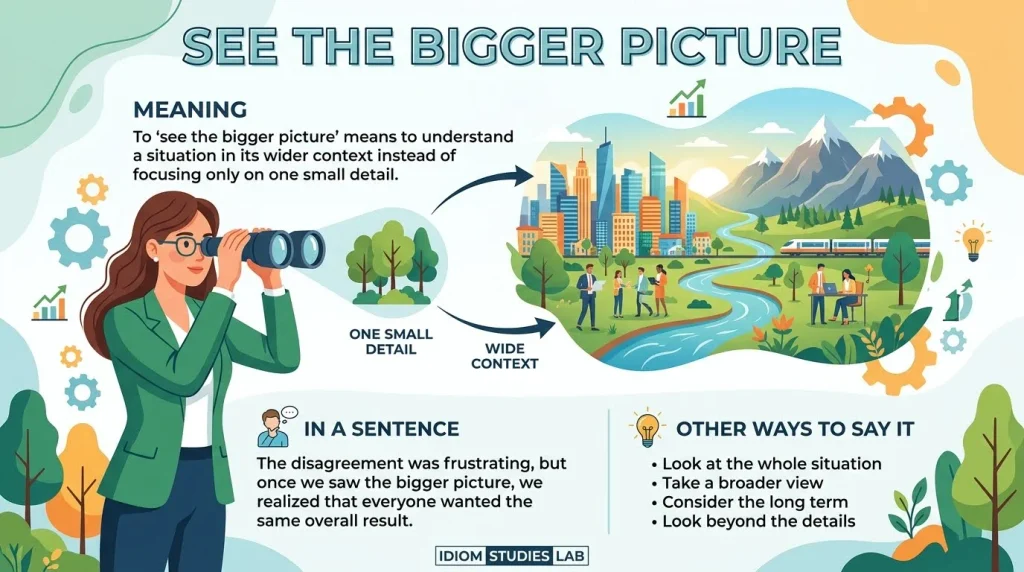
See the Bigger Picture
Meaning
To “see the bigger picture” means to understand a situation in its wider context instead of focusing only on one small detail.
In a Sentence
The disagreement was frustrating, but once we saw the bigger picture, we realized that everyone wanted the same overall result.
Other Ways to Say It
- Look at the whole situation
- Take a broader view
- Consider the long term
- Look beyond the details
Explanation
The phrase asks us to imagine stepping back from a close-up view and seeing the entire scene. For adults, it can represent perspective, patience, and thoughtful decision-making.
It is especially useful when describing emotional maturity because mature judgment often involves considering more than the immediate problem.
Best Use
Excellent for professional communication, essays, discussions, speeches, and reflective writing.
Take the Bull by the Horns
Meaning
To “take the bull by the horns” means to deal with a difficult situation directly and confidently.
In a Sentence
Rather than waiting for someone else to solve the problem, Jamal took the bull by the horns and arranged a meeting with everyone involved.
Other Ways to Say It
- Take decisive action
- Face the issue directly
- Take charge
- Deal with it head-on
Explanation
The expression creates a bold image of grabbing a powerful animal by its horns instead of running away. It communicates courage, initiative, and determination.
It is more forceful than simply saying someone handled a problem.
Best Use
Best suited to motivational writing, speeches, storytelling, workplace discussions, and informal advice.
Have One’s Act Together
Meaning
To “have one’s act together” means to be organized, prepared, responsible, and capable of managing one’s affairs.
In a Sentence
By the time she started her new job, she had her act together and knew exactly what she wanted to accomplish.
Other Ways to Say It
- Be organized
- Have things under control
- Be well prepared
- Know what you’re doing
Explanation
This informal expression suggests that the different parts of someone’s life or responsibilities are working together effectively.
It is a practical way to describe an adult who appears organized and capable, although it can sometimes be used humorously.
Best Use
Works naturally in casual conversations, workplace discussions, social media, and informal writing.
Roll with the Punches
Meaning
To “roll with the punches” means to adapt to difficulties instead of allowing setbacks to completely defeat you.
In a Sentence
Life rarely goes according to plan, so learning to roll with the punches has made him much more resilient.
Other Ways to Say It
- Adapt to setbacks
- Go with the flow
- Take things as they come
- Bounce back from difficulties
Explanation
The expression comes from boxing: moving with a punch can reduce its impact. In everyday language, it describes an adult who adjusts when circumstances change.
It suggests flexibility rather than simply enduring hardship.
Best Use
Great for conversations, motivational writing, personal stories, and descriptions of resilient personalities.
Burn the Candle at Both Ends
Meaning
To “burn the candle at both ends” means to use up one’s energy by working, staying busy, or going without enough rest.
In a Sentence
He’s been burning the candle at both ends trying to balance work, study, and family commitments.
Other Ways to Say It
- Overwork oneself
- Run oneself ragged
- Push oneself too hard
- Get too little rest
Explanation
A candle normally burns from one end, so burning it from both ends suggests using it up much faster. Applied to adults, the expression captures the pressure of trying to do too much at once.
It often carries a warning that a person’s pace may not be sustainable.
Best Use
Natural in everyday conversations, personal reflections, workplace discussions, and advice about balance.
A Breath of Fresh Air
Meaning
“A breath of fresh air” describes someone or something that feels refreshingly different, positive, or enjoyable.
In a Sentence
Our new colleague was a breath of fresh air; his calm attitude made even stressful meetings easier.
Other Ways to Say It
- A refreshing change
- A welcome change
- Refreshingly different
- A positive influence
Explanation
The phrase compares a refreshing person or experience with the feeling of breathing clean, fresh air.
When describing an adult, it can suggest that the person brings energy, optimism, honesty, or a new perspective.
Best Use
Suitable for compliments, personal writing, workplace conversations, reviews, and storytelling.
At a Crossroads
Meaning
“To be at a crossroads” means to be at a point where an important choice or life decision must be made.
In a Sentence
After years in the same career, he felt he was at a crossroads and needed to decide what he really wanted next.
Other Ways to Say It
- Facing a major decision
- At a turning point
- Choosing between paths
- At a critical stage
Explanation
The image is of a road intersection where a traveler must decide which direction to take. For adults, it can represent career changes, relationships, personal growth, or major life choices.
It is naturally reflective and can carry a serious or hopeful tone depending on the context.
Best Use
Especially effective in essays, personal stories, speeches, poetry, and reflective conversations.
Exercise: Practice Using Idioms
Test yourself with these 15 questions. Choose the answer that best explains the expression or completes the sentence.
Question 1: What does “stand on one’s own two feet” mean?
A. To maintain a regular exercise routine
B. Gaining independence
C. Traveling without a companion
D. Escaping personal responsibilities
Question 2: If someone “has a lot on their plate,” what does that usually mean?
A. Consuming excessive amounts of food
B. Handling numerous duties
C. Preparing food for a gathering
D. Enjoying lots of leisure time
Question 3: Which expression best describes someone who has gained considerable life experience?
A. A breath of fresh air
B. At a crossroads
C. Been around the block
D. Bite the bullet
Question 4: Maria is facing a difficult problem directly instead of avoiding it. Which idiom fits best?
A. Take the bull by the horns
B. Keep one’s feet on the ground
C. Burn the candle at both ends
D. A shoulder to cry on
Question 5: What does “weather the storm” communicate?
A. Avoiding bad weather
B. Enjoying an outdoor activity
C. Surviving a difficult period
D. Preparing for a vacation
Question 6: Which sentence uses “learn the hard way” correctly?
A. He learned the hard way that rushing important decisions can cause problems.
B. She learned the hard way how to swim in a pool.
C. They learned the hard way because the book was easy.
D. He learned the hard way by reading a simple definition.
Question 7: Someone who “knows the ropes” most likely:
A. Enjoys sailing every weekend
B. Understands how a situation or system works
C. Likes tying complicated knots
D. Avoids learning new skills
Question 8: What does “call the shots” usually mean?
A. Take photographs
B. Make important decisions
C. Ask for permission
D. Leave a meeting
Question 9: Which expression best describes someone who offers emotional support?
A. A shoulder to cry on
B. See the bigger picture
C. Call the shots
D. Bite the bullet
Question 10: If someone is “burning the candle at both ends,” they are probably:
A. Resting after a busy week
B. Working or staying busy without enough rest
C. Decorating their home
D. Planning a quiet evening
Question 11: Which situation best fits “at a crossroads”?
A. Someone is choosing between major life directions.
B. Someone is cooking dinner.
C. Someone has finished every task.
D. Someone is taking a short walk.
Question 12: What does “keep one’s feet on the ground” suggest?
A. Remain practical and humble
B. Become physically stronger
C. Travel frequently
D. Avoid meeting people
Question 13: Which idiom describes adapting to unexpected setbacks?
A. Put one’s house in order
B. Roll with the punches
C. Go the extra mile
D. Have one’s act together
Question 14: If a new coworker is “a breath of fresh air,” the speaker probably means the coworker is:
A. Difficult to understand
B. Physically exhausted
C. Refreshingly positive or different
D. Unwilling to cooperate
Question 15: Which expression means making more effort than people normally expect?
A. Go the extra mile
B. See the bigger picture
C. Weather the storm
D. Have a lot on one’s plate
Answers
- B — “Stand on one’s own two feet” means becoming independent and able to manage one’s own life.
- B — Having “a lot on one’s plate” means dealing with many tasks, responsibilities, or concerns.
- C — “Been around the block” describes someone with substantial practical or life experience.
- A — “Take the bull by the horns” means confronting a difficult situation directly and confidently.
- C — “Weather the storm” means surviving a difficult period until conditions improve.
- A — “Learn the hard way” refers to gaining a lesson through an unpleasant or difficult experience.
- B — Someone who “knows the ropes” understands how a system, job, or situation works.
- B — “Call the shots” means being the person who makes important decisions.
- A — “A shoulder to cry on” describes someone who offers sympathy and emotional support.
- B — “Burn the candle at both ends” refers to using too much energy by staying busy without enough rest.
- A — “At a crossroads” describes a point where an important decision or change is approaching.
- A — “Keep one’s feet on the ground” means staying realistic, practical, and humble.
- B — “Roll with the punches” means adapting to difficulties and setbacks.
- C — “A breath of fresh air” describes something or someone pleasantly refreshing or different.
- A — “Go the extra mile” means making more effort than is expected.
FAQs
What is an idiom for adults?
An idiom for adults is a figurative expression that can help describe maturity, independence, experience, responsibility, resilience, or adult life in a vivid way. Expressions such as “stand on one’s own two feet” emphasize independence, while “at a crossroads” focuses on important life choices.
How do I create my own idioms?
Start with a clear idea, then connect it to a strong mental image. Think about what the quality looks like, feels like, or reminds you of. For example, resilience might be represented through the image of something bending without breaking. However, newly invented expressions may not be recognized as established idioms unless people begin using them widely.
What makes an idiom effective?
A good idiom creates a clear mental picture while communicating an idea that would otherwise take more words to explain. It should fit the context naturally and have a meaning that readers or listeners can understand from usage.
Can I use these idioms in everyday conversation?
Yes. Many of these expressions, including “have a lot on one’s plate,” “know the ropes,” “call the shots,” and “roll with the punches,” are natural in everyday English. More reflective expressions such as “at a crossroads” may feel especially appropriate in personal or serious conversations.
What is the difference between an idiom and a simile?
An idiom has an established figurative meaning that may not be obvious from its individual words. A simile directly compares two things using words such as “like” or “as.” For example, “He is at a crossroads” is an idiomatic expression, while “He is like a tree standing firmly in the wind” is a simile.
Conclusion
The language we use to describe adults can say much more than simply “mature,” “responsible,” or “experienced.” Idioms give those descriptions color, personality, and emotional depth. Whether you are talking about someone who has “been around the block,” describing a person who can “roll with the punches,” or writing about someone who is “at a crossroads,” each expression highlights a different part of adult life.
The best figurative language is not necessarily the most dramatic. It is the expression that fits the person’s situation and communicates the intended feeling clearly. Use these idioms thoughtfully in conversations, stories, essays, speeches, and personal writing, and let the image do some of the explaining. After all, adulthood is not one single experience it is a collection of choices, challenges, lessons, and moments of growth.

Eleanor Prose is a writer and English teacher with a soft spot for the phrases that trip us up. She has spent years helping students and professionals use idioms with confidence not just memorizing them, but understanding the culture and humor behind each one.
Through Idiom Looms, Eleanor explores the threads that connect language, history, and everyday conversation. Her goal is simple: to make English idioms clear, memorable, and actually fun to use.
She writes from a quiet desk surrounded by notebooks, and firmly believes there’s an idiom for every situation usually more than one.



[…] Read more:20 Idioms for Adults With Real Examples […]